Procurement as a differentiator – Part 1

“In 2020, company leadership will likely look at procurement not as a group that focuses on sourcing raw materials, goods and services, but rather as one that sources ideas. Creativity will involve engaging stakeholders in new, innovative ways” -Deloitte, Charting the Course, Why Procurement must transform itself by 2020
Over the recent years, the procurement profession has started going through a transformation from a clerically oriented function to becoming a strategic contributor, embracing supply chain management principles.
Organisations slowly but surely have started investing in procurement, acknowledging the importance of strategic cost management.

So, what would be the next step Procurement should aim for? Moving beyond Cost Cutting, can Procurement become a core differentiator for every Organization? I believe the answer is yes. Let’s have a closer look.

Royce Blair - Starfish - Different

PROCUREMENT DEFINITIONS

Discussing Procurement, there is a variety of different elements to it: Direct, Indirect, Sourcing, Category Management, Contract Management, Supplier Relationship Management, Procurement Excellence, the list goes on.

In the traditional way of looking at Procurement (see below definition) it can be argued that not all these elements can be considered core.

However, if we expand our definition of Procurement from the more traditional approach of:

Procurement is “the overarching function that describes the activities and processes to acquire goods and services involving establishment of fundamental requirements, market research and vendor evaluation and negotiation of contracts including the purchasing activities required to order and receive goods” – purchasinginsight

to also engulf activities such as:

“make-versus-buy decisions, outsourcing and in-sourcing, supply chain management, inter-firm communication, strategy formulation, relationship management, performance assessment, inter-firm networking and innovation scanning” (Cousins P. et al, 2008, Strategic Supply Management)

then it becomes apparent that Procurement has the potential, if viewed strategically, to effectively link customer demand with supplier innovation and thus, change the way we view Procurement’s core elements.

In a practical sense though how Procurement fits in organizational Strategy and why should it be there?

Some thoughts are summarized below:

A) THE LINK BETWEEN CUSTOMER DEMAND AND SUPPLIER INNOVATION

a) Firstly, it is evident that Procurement is the function that forms the contract framework and the supplier relationship.

Hence, provided that the business outlook, targets and organizational vision allows, Procurement is responsible for defining the scope and setting the framework within which the supplier relationship will evolve.

In recent times, the requirement for suppliers to work with the business into strategic relationships (especially, discussing categories of high spend and/or high risk) is slowly becoming the norm.

Contract clauses that require continuous improvement and innovation as part of the contract are implemented more and more.

b) Procurement is also the function that has direct contact with new suppliers.

The business is well aware of what the current suppliers can do (although there may some gaps especially when the contract doesn’t promote sharing of new ideas and incentives for continuous improvement). However, the business does not know what it doesn’t know.

Hence, unless Procurement through its contacts re-assesses the supplier market and re-evaluates of what can be done e.g. what the suppliers’ new processes are and how innovation affects the market landscape, then the fast-paced market space we operate in may constitute the business activities too expensive and/or irrelevant by today’s standards.

It thus becomes evident that it would be very useful, if not essential, for the Organization to make Procurement the focal point of collective knowledge between internal functions and external sources.

Procurement can thus, be placed as the liaison between R&D, Sales and Operations on one hand and Suppliers on the others.

Furthermore, in pursuit of establishing the “fundamental requirements” or specifications for Sourcing the right products and services, Procurement has to assess supplier capabilities and can and should collect and communicate market intelligence back to the business in order for best practices and product development to be fine-tuned.


In the next two posts (part 2 and part 3) of this three part series, I will explore how Procurement’s potential through could reinforce the basic Strategies of Organizational differentiation and what this differentiation could look like.


==========================================================================

Image courtesy of Royce Bair / www.flickr.com

 

How to make stress your friend?

“Choosing meaning in οne’s life is much better than avoiding discomfort”

                                                                                         Kelly McGonical

I was inspired to see this great video from Kelly McGonigal at TED.com.

Focusing on stress mainly, Kelly made a compelling case for the benefits of  choosing the right attitude towards what are perceived stressful situations, providing very tangible study results.

Kelly McGonical

Kelly McGonical

Moreover, she also highlighted the importance of “Caring”  in the overall equation as a mechanism to handle the negative effects of stress.

Caring for others, caring for a cause assists us to handle stress in a positive manner. Thus, the Caring and having a Positive Attitude are enablers that assist us to choose meaningful projects despite the difficulties that these may have.

I think this is a inspiring video that reinforces the view that one of the key aspects of a new employee should be to Care. Care about others, care about doing quality work and care about delivering outcomes.

Check out Kelly’s talk here:

Therefore, it becomes apparent, that connecting with others, caring and having a positive outlook on life and its challenges has clear health benefits.

So, one of the best investments to your organization’s success and your employees health is if during your next interview you also look for cues that prove that people can i) connect and ii) they have and will care.

If you want to read more regarding what I regard as essential qualities for choosing team members, check out my blog post on this matter The 4 basic qualities of an exceptional team member, Caring is one of these qualities.

===================================================================

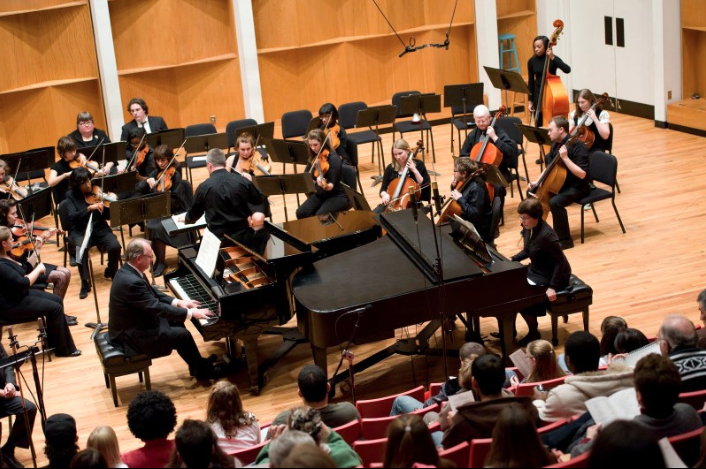
The Leader’s role in setting and keeping the tune!

Recently, Julian Barson posted an interesting remark about the changing nature of business and the role of leadership (post can be found here).

I have posted before about Leadership (here) in the form of a jungle story. Reflecting on Julian’s remarks I believe that there may be another way to think of a leader though.

East Stroudsburg University

Leadership has been resembled by some to conducting an orchestra in terms of conducting a well tuned symphony. I think this is a good start but not the whole story. We should remember that

Excellent pre-work is what ensures the successful performance.

THE SUCCESSFUL ORCHESTRA

Imagine a very prolific conductor of an orchestra who is also the executive producer. She has the passion required, a limited budget and the whole genre of music to choose from, whilst she is operating in a rapidly-changing hypercompetitive environment.

Starting with a vision of where the orchestra should go towards (the so called, True North), putting a competent team together, setting the goals, selecting the orchestra’s target market (which involves the musical genre and particular segmentation and selection), identifying the value proposition and communication channels including frequency and style and ensuring that the “product” is differentiated enough to attract audiences as well as, ensuring that the resources available are best utilised and lobbying is performed for acquiring new resources are, only the start.

Then, the conductor/producer needs to select the orchestra instruments, the right orchestra performers, position them right, select the compositions to be performed, select the venues, the style of music, the time of the performance, keep the orchestra attuned and also get the orchestra to set its own tune.

Setting your own tune

Discussing music, the orchestra’s journey of setting its own tune is a big challenge as, unless there is some kind of familiarity the audiences may not attend.

It is thus worthwhile remembering that:

“We enjoy the familiarity of old tunes as we comfort in the security of the subsequent verse”

On the other hand though, the conductor needs to surpass this familiarity by differentiating the orchestra’s value proposition enough, to keep the audience captivated.

Perform and Delight

And as the saying goes “you are as good as your last performance”.

So, the pressure is on and the expectations need to be set high for audiences to attend. And then, expectations need to be met and hopefully exceeded, creating the much required sense of delight to the audience so that, these come back for more next time.

Continually adhering to these principles means that the conductor will lead the orchestra to success.

Examples

A great example of differentiation, as well as, transformation of a whole industry is, the paradigm of Cirque de Soleil, (you can read more in the now classic book “Blue Ocean Strategy” by Kim and Mauborgne) (a snapshot can be found here).

As Hubbard et al. detailed in another great book titled “The First XI” the “attunement” or alignment of key elements in an organisation is a key for organisational success.

Specifically,

“Alignment of External Environment, Strategy, Capabilities, Culture, Systems, People, Leadership, Structure, Communication, Perceptions” is a key to a winning organisation. – The First XI: Winning organisations in Australia. Hubbard et al.

ORCHESTRA OF ONE

A final note to consider.

Each of us can and should choose our own tune to orchestrate. A fantastic initiative from the Melbourne Symphony Orchestra highlights this point. Enjoy the video below:

Each of us can and should aim to be an orchestra of one. Remember in an orchestra the conductor is the Leader but for example, you also have a lead violin and you can have solo performances equally captivating (see Zoe Keating’s one woman cello band).

As the saying goes said:

Life is not to be spend on the spectator’s seat, get on stage.

It is important to aim to Lead something of importance to us. And if we are in such a position to enable others to become leaders themselves (see here, here and here my posts on team engagement and enablement).

I do believe that the successful companies of tomorrow will be companies of Leaders. Each employee should aim to become a leader on a particular field and will be enabled by a Leader/Conductor who will be setting the tune.

What have you Lead lately?

[Image courtesy of East Stroudsburg University / www.flickr.com]

Employee Engagement: Practical Tips for a more productive culture in the workplace – Presentation

Thanks to the Chartered Institute of Logistics & Transport Australia (CILT Australia) for hosting my webinar “Employee Engagement: Practical Tips for a more productive culture in the workplace” on the 26th November 2013. The presentation was very well received and the feedback and questions I got afterwards were thought provoking. For those that missed it this is the presentation. Additionally, the sound recording can be accessed by CILT Australia members here.

BACK UP RESOURCES

This presentation was the culmination of various posts and years of work. If you want to revisit the Employee Engagement concepts in more depth you can read more here, here and here. The Productive Culture Survey background can be found here, details about NPS surveys here, thoughts on the basic qualities of a effective team member here and thoughts on the basic qualities of an effective team can be found here and here. Finally, if you wanted a simple guide on how to go about innovating, similarly to what I have done with various elements in this presentation, to suit your own individual needs read this simple method here and here.

WEBINAR BRIEF AS PUBLISHED BY CILT AUSTRALIA:

Event Description:
What is the difference between motivation and employee engagement?
In this presentation the view that employee engagement should be the preferred target will be analysed.

Why is employee engagement important?
Practical ways to assess the Productive Culture in the workplace will be discussed.

What is the link between employee engagement and job satisfaction? What are the elements that constitute job satisfaction?

Practical examples on how these elements can be further stimulated will also be in the offing as well as the opportunity to download free material that will assist you to assess the existent culture of your team and make your team more effective.

Guest Speaker:
George Vrakas (MBA, CMILT)