The 9 Elements of an Effective Team (Part 2)

Last week (Part 1), I listed the 9 Elements that make an effective team.

These are:

1) Clear Goals

2) Good Team Structure

3) Right Culture and Skillset selection

4) Trust

5) Good Communication

6) Positive relationships

7) Accountability

8) Leadership

9) Feedback

Then, I specifically explored the first 4.  Let’s now look at the remainder.

wpid-Photo-28-Sep-2013-229.jpg

5) Good communication – Establish the environment for thriving innovation, participation and motivation within the team environment.

Conflict will come about. The important thing is to address it straight away and not let it eat away the foundations of the team.

Focus on strengths, frequent, positive and constructive feedback.

6) Positive relationships

The leader should give the example of taking risks and accepting that not all things will succeed. Then, praise the successes and support the missed targets enabling the team to lift their performances to the circumstances.

Some simple tips:

●     Select team members wisely.

●     Make choices based on merit.

●     Open communication channels between the team members. Each team member learning about each other is important so that each one appreciates and supports each other.

7) Responsibility and Accountability

Giving credit where it’s due but also holding people fully accountable for their actions or in-actions is always important.

As Roger Connors et al. highlight in their great book “The Oz Principle

“Individual and organizational results of people improve dramatically when people overcome the deceptive traps of the victim cycle and take the Steps To Accountability.”

But how do you identify if your team has such issues  e.g. if the team is trapped in the “victim cycle”.

A good first step is to observe if any of below practices are existent during the team’s interactions. Does the team:

  1. Ignore an issue or deny an issue exists
  2. Displays a “It’s not my job” attitude
  3. Engages in “Finger Pointing”
  4. Displays a constant “Tell me what to do” attitude.

8) Leadership

Maintain the context and scope of the team’s existence relevant and current to the shifting organisational goals.

Communicate the purpose and engage with each team member so that everybody understands how they fit in the wider picture and why what they do matters and affects the success of the company.

Lead by example!

9) Feedback.

Feedback is the underlying factor that ties everything together.

Unless there is a clear positive mechanism for non judgmental feedback loops then errors get repeated and eventually all the 8 other elements get affected.

A great feedback model can be found (here).

CONCLUSION AND ADDITIONAL RESOURCES

So, it seems that despite the varying nature of teams nowadays there are some elements that are common for every successful team.

Creating an effective team unit aims at a simple target best elaborated by Jim Collins when he described “superior work environments” this way:

“When you combine a culture of discipline with an ethic of entrepreneurship, you get the magical alchemy of great results.”

The above may seem quite intimidating at first but as suggested here, focusing on one thing at a time you will find that, not before long, the team will start entering the virtuous circle of effectiveness.

You can also find more resources on Team Development in previous posts dealing with measuring employee satisfaction, 3 essential targets for employee engagement, as well as, some thoughts on employee motivation versus employee engagement and why the latter is the real target.

Are there other elements you believe to be crucial for effective teams?

[Image credit: 123rf.com]

The 9 Elements of an Effective Team (Part 1)

What are the building elements and structure of effective teams?

Teams have varying demands bestowed upon them in terms of efficiently doing the pre-allocated work but also maximising contribution to the organisation and keeping up to speed with varying business needs. Different business environments have different team structures that work for them e.g. self-organising, rigidly structured, matrix, adhoc. There are though some elements that every team should possess in order to be effective. Let’s see what these may be.

3199990-small-group-of-business-people-joining-hands-low-angle-view

ELEMENTS OF AN EFFECTIVE TEAM

The elements that are crucial for the well being but also the smooth operation and success of a team can be summarized as follows:

1) Clear Goals

2) Good Team Structure

3) Right Culture and Skillset selection

4) Trust

5) Good Communication

6) Positive relationships

7) Accountability

8) Leadership

9) Feedback

1) Clear goals – Why does the team exist?

As I have alluded to (here), one of the key ingredients for success is the alignment of targets and culture between the Organisation, the business unit and each individual team.

Imagine the Organisation as a rowing boat with each individual rower (representing business units or teams) being misaligned with the organisational targets and rowing out of sync. The boat will make very little progress if at all even if it manages to make some headway.

Now, imagine the same boat with each team, business unit in full alignment with the organisational goals and rhythm. That is how champion teams operate (this analogy comes from Ram Charan‘s book “What the CEO Wants You to Know”).

2) Good Team structure

As I mentioned above the teams in today’s world come in many shapes and forms e.g. project teams are common nowadays.

Hence, ensuring that the right departments are involved in the formation of the project team and formulating a team structure that compliments the expected outcomes is of the essence.

e.g.  when putting together a team with a creative target then having a design that is autocratic, rigidly hierarchical does not promote open communication of ideas between all members and will most likely not produce or heavily delays a good result.

3) The Right Culture and Skillset Selection – Identification and selection of the right culture of people and skillets that compliment each other and can work to the maximum benefit of the company.

This is an expansion to element number 2 noted above e.g. knowing that IT, Finance, Sales and Procurement need to be involved is one thing. Selecting the right people from within these departments is another. Usually, Projects teams need to have within them a wide selection of influencers in order to be effective.

e.g. discussing Project teams, it is important that members of the team include i) someone that can get buy in from Top Management (usually an executive leader), ii) someone with experience in the project field who can ensure that pitfalls are avoided and the  scope and available options can be fully explored and articulated and finally, iii) someone who has the relationship power to engage and get buy in from outside teams and departments.

4) Building a culture of Trust.

● Trust is a sine qua non for any effective relationship. Without it communication falls short of any meaningful exchange of ideas as time usually is taken up on resolving conflict and misunderstandings.

A couple of simple tips to build trust is:

● Do what you say you will.

● Be honest and embrace open communication.

At next week’s post (Part 2), I will discuss the remainder of the elements 5 to 9.


[Image credit: 123rf.com]

How can you measure Employee Satisfaction using an NPS® survey?

So, you are leading a great Organisation, a great division, you are a great manager, supervisor, team leader, you are funny and everybody wants to work with you. You provide feedback, your employee retention rate is high, your team loves you and other departments look forward to the opportunity of collaborating with your team.

That is a common way to believe about ourselves and our teams. But is there a way to quantify this feel-good notion and see if there are gaps we could improve on. To see if, at the end of the day, our notion holds true?

One way of testing this notion is by modifying a common survey metric used extensively for measuring customer loyalty and customer satisfaction. The NPS® (Net promoter Score) survey.

I did this by using a common method for innovation I blogged about here and here (i.e. SCAMPER).

NPS® (Net promoter Score)- for Organisations

The concept of the Net Promoter Survey was introduced by Fred Reichheld in his Harvard Business Review article called “The One Number You Need to Grow”.

A simple definition is this:

Net Promoter is a management tool that can be used to gauge the loyalty of a firm’s customer relationships. (Wikipedia)

The concept is simple because it is based on one question that is easy to answer and pretty straightforward.

For an Organisation the NPS®® question is:

How likely is it that you would recommend our company to a friend or colleague?

An quick recap of the method can be found below:

  1. Ask the question to a sample base (key customers, account managers etc). The greater the sample base the more accurate the results.
  2. Collect the data and establish percentages for below categories.

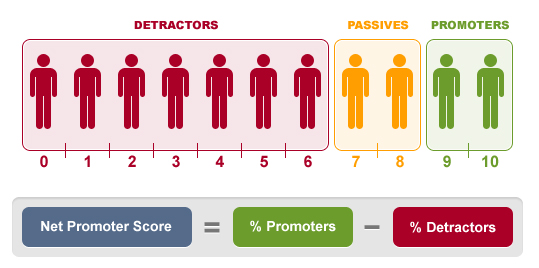
          i). Percentage that answered 1-6 (these are considered detractors)
         ii) Percentage that answered 7-8 (these are considered passives)
        iii) Percentage that answered 9-10 (these are considered promoters)

Then deduct (the % score that answered 9 or 10) from (the % score that answered 1 to 6). The outcome is your Net Promoter Score. See below illustration for easier reference.

Net Promoter Score (checkmarket.com)

You can then compare it to an industry benchmark or establish a trend of how your NPS® trends over time.

Of course, just asking the question and getting a good or a bad result is one thing. Understanding of why you are getting such a score is another.

So, the NPS® question should be followed or accompanied by a more comprehensive customer survey. Additionally, having a customer relationship journal (CRM systems) capturing customer feedback and constantly reassessing what the customers really value or find worth paying for, assists in influencing your decisions and thus, improving the next NPS® result.

Modified for use within Teams

For team members or employees in general the question can be modified as follows:

Considering your experience working for [insert team or company name], would you recommend to others to join [insert team or company name] when a position becomes available?

Modified for use within Teams

For a team the question can be modified as follows:

Considering your complete experience with the [insert name of team], how satisfied are you with the products and services that the [insert name of team] provides?

Necessary Caveat

There is a caveat. IF you are unwilling to change your ways based on the feedback provided or don’t intend to keep an open mind, THEN these surveys and feedback sessions can, and most probably will, do more harm than good.

This is because people will not trust that you genuinely want their input and so, will either not provide genuine feedback or avoid participating altogether (in both these situations you lose).

At next posts we will see two practical ways of getting specific feedback from your team/ employees so, from an informed position, you can influence the NPS® score.

So, what is your NPS® score? Is this what you envisaged?

[Image credit: 123rf.com]

How to eat an elephant?

Most of the projects that can make a difference in today’s world are big, complex, risky and generally prone to failure.

How does one counter this uncertainty and maintain a steady course?

Firstly, ask the right questions!

“Asking the right question is half the answer” Aristotle

Then, set your goal – your True North – and persevere in staying the course!

As Thomas Edison, a great prolific inventor, once said:

“I have not failed. I’ve just found 10,000 ways that won’t work.” Thomas Edison

What Edison suggests is that perseverance and hard work eventually pays off. He has 1,093 US patents to prove it.

Along the same lines, I have found the below story from the Jim Collins inspiring and tremendously helpful in keeping me focused when dealing with complex, big projects:

The 20-Mile March from Book Great by Choice by Jim Collins

Amundsen vs. Scott – Conquering the South Pole:

The round trip trek was roughly fourteen hundred miles, the equivalent of the distance from New York to Chicago and back.The environment was uncertain and unforgiving, where temperatures could easily reach 20 degrees below zero F even during the Summer.They had no means of modern communications – no cell phones, no satellite links, no radio – a rescue would have been improbable were they to err.One leader led his team to victory and safety.The other led his team to defeat and death.

Throughout the journey, Amundsen adhered to a regimen of consistent progress, never going too far in good weather, careful to stay away from the red line of exhaustion that could leave his team exposed, yet pressing ahead in nasty weather to stay on pace.Amundsen throttled back his well-tuned team to travel between 15 and 20 miles per day, in a relentless march to 90 degrees south.When a member of Amundsen’s team suggested they could go faster, up to 25 miles a day, Amundsen said no.They needed to rest and sleep so as to continually replenish their energy.In contrast, Scott would sometimes drive his team to exhaustion on good days and then sit in his tent and complain about the weather on bad days.At one point Scott faced 6 days of gale force winds and traveled on none, whereas Amundsen faced 15 and traveled on 8.Amundsen clocked in at the South Pole right on his pre-decided pace, having averaged 15.5 miles per day.Scott in contrast fell behind early, with no plan of a daily pace, and as the conditions worsened, enhanced by his lack of preparation for unforeseen events, he and his team never recovered.


There are countless times I have used this technique to tackle the most daunting of tasks.

The key is to set a constant and keep on it without thinking about the total. Before you know it you are there and most importantly you have enjoyed the journey!!!

e.g. I remember I needed to go over a textbook of 1000 pages. Reading 1000 pages is daunting but breaking down the task and focusing on disciplined reading of 30 pages a day made the task achievable and easy to tackle. A friend has used the same technique to run a marathon. There are a variety of examples if you think about it.

Remember,

“A journey of a thousand miles begins with a single step”. Lao Tzu


So, as the saying goes: How to eat an elephant?

– A bite at a time!


Do you have a 20-mile March task you have been putting off for a while? Now, may be a good time to start.

Happy Marching!


[Image credit: 123rf.com]