5 Approaches to a Negotiation – (Negotiations and everyday life)

The ability to negotiate effectively is one of the key skills to have in life.

Do you have a practical model to think about a negotiation? Something that will work at a fruit market as well as a high status negotiation table.

Read on if you want to find out about a model I have found extremely useful and easy to explain to my 9 year old, as well as, esteemed colleagues and can be used as an additional framework for any occasion.

file000879481399

WHAT IS YOUR PREFERRED STYLE?

Before you read about this particular model check the below case study and choose your 2 preferred responses.

This will provide an indicator to your preferred negotiation style.

CASE STUDY

You hire a component for a particular gadget and the contract is up for renewal. Your supplier, who you have used for a while has good service quality but not excellent. Your company is expanding with the requirement for this component increasing by 30%, and therefore are looking for a reduction in the price. You would settle for no price increase; your boss would be satisfied if an increase was held to 2 per cent. Your supplier’s first offer, taking into account the increased volume, is at the same unit price as last year. How do you respond?

Potential Responses

  1. Accept the offer
  2. Explain you were looking for a 10% reduction, ask to be met halfway, i.e. a 5% reduction in the unit price
  3. Explain that you should also be looking elsewhere as a matter of company policy
  4. Stress the 30% increase in business you have to offer and the fact that the basic cost of the equipment has fallen, due to improvements in technology
  5. Suggest improved payment terms and a longer contract period in exchange for a better offer.
  6. Show appreciation for the offer that has been made and mention the ‘bad time’ users have given you over servicing

Now, spend a minute to consider your answers. Remember choose only two of the above six choices.

Ready. Well done! Let’s move on.

THE MODEL

Categorisation is essential for it is the way to frame and really understand how things work. In this model, the negotiation approaches are split in the below general categories (the #numbering corresponds to the above suggested responses):

  • Logic #4
  • Threat #3
  • Emotion #6
  • Compromise #2
  • Bargaining #5
  • and then there is Acceptance #1 but then this is not really a negotiation (if Acceptance is the first response).

So, which were your preferred responses?

Your choices are an indicator of what is your instinctive preferred style is.

What you choose to use at every negotiation should be quite different and should dependent on the context, the relationship, the required outcome etc.

Using one behavioural style at every negotiation despite the different power dynamics and the different preferred outcomes is not wise as this would not enhance the potential for maximising the value of the deal.

For example, as an extreme case, imagine you have decided upon a collaborative approach for R&D (mutual product development) with a supplier but your natural style is to Threaten (#3). Well, this is not an approach that builds bridges towards greater collaboration.

WAYS TO USE THE MODEL AND BE EFFECTIVE AT A NEGOTIATION

1. Know what you naturally prefer (in this CIPS white paper there is a test that more accurately measures your negotiation style)

2. Pay attention on what is the preferred method from the other side.

An easy way to do this is to identify key themes. Notice again the above 6 responses and compare them for key differences.

3. Get on your team people with natural talent at different negotiation style.

4. Prepare, Prepare, Prepare. Prepare on what style and arguments you should use. Prepare for what naturally you would expect from the other party. Prepare BATNA, WATNA etc

FURTHER USEFUL READING

Previous Blog posts about Negotiations:

  • Definition on what the term negotiation really means (here).
  • The first step towards an effective negotiation (here).
  • A useful guide to identify and avoid bad reasoning in a Logical argument (here).
    A checklist on prerequisites for an effective negotiation (here)

Great Books

  1. Clive Rich- The Yes Book
  2. Robert Cialdini – Influence
  3. Roger Fisher & William Ury – Getting to Yes


[Image courtesy of Andalousia / www.morguefile.com]
The Iron Triangle – A great tool for successful Procurement and Contract Management

How do you distinguish if you pay too much? What are the elements you need to have in mind when putting together a deal?

There may be a lot of books and literature that describes this point. Nothing I have found though, makes this clearer than the concept of the Iron Triangle.

The Iron Triangle was part of a presentation by Sara Cullen at an IACCM workshop in Melbourne last year (you can find this concept in her book Outsourcing: All you need to know).

After hearing about this concept, I found that I was using it in discussions with colleagues more and more and that it was very useful to clarify situations and issues.

So, I thought I’d share it with you along with some tips on how to avoid been caught in what is called the “Winner’s Curse”.

Screen Shot 2014-02-13 at 9.43.15 pm

THE EXAMPLE

Sara, in her book, mentions the example of a retailer’s IT department (the Customer) who chose to go to tender for the data centre operations placing big emphasis on the price, on the belief that the services and the providers themselves were undifferentiated. So, the lowest bid (30% below the second lowest) won the tender. Value for money was not assessed or thought it was of importance.

Very quickly in the deal though, scope and price variations became the norm. KPIs were not achieved as these had been set up as targets and not as minimum standards and the Customer had not dedicated time to develop an SLA that was customised to the Customer’s needs.

Additionally, the Customer had now to dedicate a full resource to variation management. Demand peaks had not been accounted for within the tender price and so, even more resources had to be acquired. The story goes on.

So, as you can appreciate the total cost of this contract was very high. Actually, Sara reports that it was higher than the highest bid and the Customer was constantly preoccupied with fighting fires rather than adding value.

This a typical case of what is called the Winner’s Curse.

THE IRON TRIANGLE AND THE WINNER’S CURSE

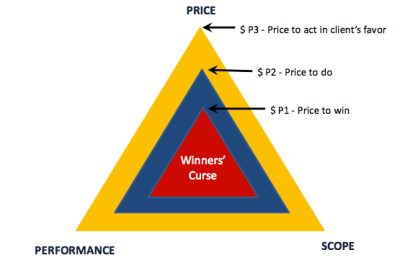
To better understand what happened, we have to look at the concept of the Iron Triangle (picture above).

The Iron Triangle reflects the basic three elements of a successful deal. These are:

  1. Scope – what the products / services are.
  2. Performance (Quality) – what standards are required for the products / services
  3. Price – what price will be paid for the products / services

Focusing on the Price levels for now, this concept depicts three different price levels with the analogous levels of Scope and Performance (Quality).

1. The Winner’s Curse – This is the price a bidder will bid in order to win a tender. (P1)

2. Price to do – This is the price required to do the job including a reasonable margin (P2)

3. Price to act in Customer’s favor – The highest bid of all which corresponds to the highest quality and scope (considered in Customer’s favor) (P3).

In the above example, what the IT department (the Customer) failed to understand is, that selecting the vendors based on the P1 price level (the Winner’s Curse) means that the Provider needed to cut corners to recover its cost and potentially make a margin.

On the other hand, the expectation the Customer has in terms of Performance (Quality) and Scope usually resembles the corners of the Triangle corresponding to price level P3.

This means that the eventual triangle the Customer would require consists of the highest Quality and Scope levels but the lowest price. This results in a skewed triangle and is unsustainable.

Hence, what ensued the deal in the above example was the breakdown of the relationship and the spiraling of costs.

So, reflecting on the Iron Triangle, sourcing should be a search for the best value for money deal, taking into account the Scope, the Performance and the Price from the start.

TIPS TO AVOID BEEN CAUGHT IN THE WINNER’S CURSE

So, what are some tips to avoid been caught in the Winner’s Curse?

  • Be informed about what you want (specifications), how you want it delivered (quality), what value-additions are required (if any).
  •  Be in the know, from a Total Cost of Ownership (TCO) perspective e.g. estimate the transition costs for changing suppliers (should you want to add them in the mix) etc
  • A deal made must include clarity around these three items Scope, Quality and Price. Be sure to cover all of those from the start.
  • Have a variation process agreed.
  • Have an exit strategy should things go wrong.
  • Know the triangle you are in at every deal and prepare for any shortcomings if in fact you are forced to go for a winner’s curse.

Do you know what triangle you were part of the last time you did a deal?

Image courtesy of Sara Cullen / www.whiteplumepublishing.com

Logical Fallacies: Avoiding Common Negotiation Pitfalls

This is my full article contribution as published in TheSource e-news earlier this week.

Fail to prepare and prepare to fail! Negotiation is often 90% preparation and 10% execution and so we have enlisted senior procurement professional George Vrakas to give us his top tips on avoiding common negotiation pitfalls.

When you use logic as your approach to conduct a negotiation, the human element of the process still needs to be considered, and thus you need to be able to identify and avoid common errors in reasoning (the so-called logical fallacies) to ensure a successful outcome.
Here are George’s top 6 tips on dealing with the most common logical fallacies:

medium_8437944449

1) AD HOMINEM (go against the person not the argument)

Definition: This is encountered when someone tries to counter a claim or a position by attacking the person rather than addressing the argument.

Example: “The current system is ineffective; the vendor who implemented it was only bothered about saving costs.”

Attacking the vendor because of their alleged motives does not address the issue. What is meant by “ineffective”? What were the specifications we gave the vendor? What can be done about it? Is the system used properly? What you need to remember is that character flaws are not evidence of the validity of an argument.

2) FALSE DICHOTOMY (either/or)

Definition: This is encountered when someone reduces the possibilities in a negotiation to a simplistic dilemma i.e. it is “either black or white.”

Example: “Japanese car makers must implement green production practices, or Japan‘s carbon footprint will hit crisis proportions by 2020.”

This is a logical fallacy because it assumes there are only two options: either Japan implements green production practices or Japan will have a disastrous carbon footprint. This logic fails to consider that there may be other reasons that contribute to the carbon footprint. It also limits our thinking e.g. focusing solely on green production we may miss out on another solution such as the increase of use of public transport.

3) SPECIAL PLEADING or ADHOC REASONING (the rules don’t apply as I am special)

Definition: This is encountered when someone suggests that he/she has special privileges that do not or could not apply to others.

Example: In 1996, Steve Jobs exercised a special pleading when he, misquoting Picasso, stated that “good artists copy, great artists steal,” and continued, “we have always been shameless about stealing great ideas.”

Subsequently, Apple went on with a lawsuit against HTC for allegedly infringing on 20 of Apple’s patents. Thus, this is a logical fallacy because what Steve Jobs implied is that Apple can “copy” or “steal” ideas as good artists do, but HTC cannot.

4) APPEAL TO AUTHORITY (It is correct because he/she said so)

Definition: This is encountered when someone appeals to an “authoritative” person or agency to support one’s claims. i.e. “Manager X believes Y, Manager X speaks from a position of authority, therefore Y is true.”

Example: The Swissair airline was once so financially solvent it was called the “Flying Bank.” However, they began to believe they were invulnerable and as a result of failing to question poor decisions and gross mismanagement, and the airline eventually went bankrupt.

This case strongly implies a case of “groupthink.” Instead of looking at the data and the shifting conditions, Swissair executives seem to have been persuaded that top management knows best, and so, did not challenge this notion until it was too late.

5) NON SEQUITUR (It doesn’t follow)

Definition: This is encountered when someone reaches a conclusion which does not necessarily follow the premise of the argument.

Example: “This is new, therefore it is better.”

The fact that something is new and shiny does not mean that it will be better. New processes are generally an enhanced version of older ones, but before you make a decision, you will still need to investigate on whether: a) there is value in changing; b) the process is suitable for your specific needs; c) there are no inherent flaws etc.

6) APPEAL TO TRADITION (If it ain’t broke, don’t fix it)

Definition: This is encountered when someone claims that because something has been done in a particular way for a long time, this is the correct way of doing it.

Example: “We do not need a new ERP system. We have been doing alright using excel spreadsheets for years!”

Quite simply, there is definite value in looking to change the ways we go about things – new technologies (e.g. ERP systems), new processes (Six Sigma, Lean, TQM), the list goes on. Appealing to tradition is particularly prevalent during change management processes when people who are resistant to change raise this argument again and again.

The above six logical fallacies are just a small sample of the wide variety of bad reasoning out there. However, these are a good start on the journey to establishing integrity in logical arguments during a negotiation.

Now, put them to the test in your next negotiation!

[Image courtesy of Les Haines / http://www.flickr.com/]

It takes two to tango…

Recently, I was reading the excellent book from Clive Rich titled “The Yes Book” and was reminded of a simple truth.

It takes two to tango!

Tango

A SIMPLE CHECKLIST

When entering a negotiation we sometimes carry certain preconceptions e.g. that the other party has an open mind about the result or that we know what the drivers, wants and needs the other party has.

Well, it would have been nice to live in an ideal world but unfortunately, reality is much more complicated.

As Clive mentions in his book:

“For a negotiation to take place the following elements must be present:

  • There must be two or more parties,
  • they must at least be prepared to reach agreement,
  • they must have some interests in common and some conflicting interests to resolve,
  • Those involved must have the freedoms to meet each other’s needs,
  • Those involved must be willing to be explicit to some degree about their wants and needs,
  • Those involved must be prepared to compromise to some degree.” Clive Rich (The Yes Book)

The above is a useful list to have when entering a negotiation.

As mentioned here, embracing the second position is the key to an effective negotiation. This means that you approach each occasion without misconceptions or false assumptions but explore interests, needs, wants and attitudes for what they really are.

.


[Image courtesy of Aracelota / flickr.com]