Procurement as a differentiator – Part 1

“In 2020, company leadership will likely look at procurement not as a group that focuses on sourcing raw materials, goods and services, but rather as one that sources ideas. Creativity will involve engaging stakeholders in new, innovative ways” -Deloitte, Charting the Course, Why Procurement must transform itself by 2020
Over the recent years, the procurement profession has started going through a transformation from a clerically oriented function to becoming a strategic contributor, embracing supply chain management principles.
Organisations slowly but surely have started investing in procurement, acknowledging the importance of strategic cost management.

So, what would be the next step Procurement should aim for? Moving beyond Cost Cutting, can Procurement become a core differentiator for every Organization? I believe the answer is yes. Let’s have a closer look.

Royce Blair - Starfish - Different

PROCUREMENT DEFINITIONS

Discussing Procurement, there is a variety of different elements to it: Direct, Indirect, Sourcing, Category Management, Contract Management, Supplier Relationship Management, Procurement Excellence, the list goes on.

In the traditional way of looking at Procurement (see below definition) it can be argued that not all these elements can be considered core.

However, if we expand our definition of Procurement from the more traditional approach of:

Procurement is “the overarching function that describes the activities and processes to acquire goods and services involving establishment of fundamental requirements, market research and vendor evaluation and negotiation of contracts including the purchasing activities required to order and receive goods” – purchasinginsight

to also engulf activities such as:

“make-versus-buy decisions, outsourcing and in-sourcing, supply chain management, inter-firm communication, strategy formulation, relationship management, performance assessment, inter-firm networking and innovation scanning” (Cousins P. et al, 2008, Strategic Supply Management)

then it becomes apparent that Procurement has the potential, if viewed strategically, to effectively link customer demand with supplier innovation and thus, change the way we view Procurement’s core elements.

In a practical sense though how Procurement fits in organizational Strategy and why should it be there?

Some thoughts are summarized below:

A) THE LINK BETWEEN CUSTOMER DEMAND AND SUPPLIER INNOVATION

a) Firstly, it is evident that Procurement is the function that forms the contract framework and the supplier relationship.

Hence, provided that the business outlook, targets and organizational vision allows, Procurement is responsible for defining the scope and setting the framework within which the supplier relationship will evolve.

In recent times, the requirement for suppliers to work with the business into strategic relationships (especially, discussing categories of high spend and/or high risk) is slowly becoming the norm.

Contract clauses that require continuous improvement and innovation as part of the contract are implemented more and more.

b) Procurement is also the function that has direct contact with new suppliers.

The business is well aware of what the current suppliers can do (although there may some gaps especially when the contract doesn’t promote sharing of new ideas and incentives for continuous improvement). However, the business does not know what it doesn’t know.

Hence, unless Procurement through its contacts re-assesses the supplier market and re-evaluates of what can be done e.g. what the suppliers’ new processes are and how innovation affects the market landscape, then the fast-paced market space we operate in may constitute the business activities too expensive and/or irrelevant by today’s standards.

It thus becomes evident that it would be very useful, if not essential, for the Organization to make Procurement the focal point of collective knowledge between internal functions and external sources.

Procurement can thus, be placed as the liaison between R&D, Sales and Operations on one hand and Suppliers on the others.

Furthermore, in pursuit of establishing the “fundamental requirements” or specifications for Sourcing the right products and services, Procurement has to assess supplier capabilities and can and should collect and communicate market intelligence back to the business in order for best practices and product development to be fine-tuned.


In the next two posts (part 2 and part 3) of this three part series, I will explore how Procurement’s potential through could reinforce the basic Strategies of Organizational differentiation and what this differentiation could look like.


==========================================================================

Image courtesy of Royce Bair / www.flickr.com

 

The 4 absolute basics to a contract deal (the 4Ps)

What are the absolute basics towards a steady foundation for a written deal?

Imagine that you have been working on a deal for weeks and during a meeting with the supplier (or customer) you reach a breakthrough agreement. Both parties are quite excited and shake hands. Is this enough?

Certain cultures consider this to be enough.

Irrespective of the integrity (character) of both parties though, it is always best to write things down as a Letter of Intent (LOI) or a Memorandum of Understanding (MOU) or Agreement (MOA).

But what do you actually need to take down as a minimum to make this deal valid, workable and to later avoid disputes.

Read on if you want to find out the 4 elements that are widely acknowledged as the absolute basics to a deal.

handshake

The 3 Ps

A deal is considered to be valid if it refers to three basic elements commonly known as the 3Ps. These are:

  1. Parties
  2. Price
  3. Product

It is quite obvious that if we do not have the parties that are covered, the price agreed (and what is included and excluded in the rates) and the product (an exact description of what the product/service is and any agreed variations) then, really, there is no deal. As without these elements there is inadequate clarity to any deal.

3Ps augmented – (the IRON TRIANGLE contribution)

I don’t believe that the above are enough though in the current environment as I have elaborated here based the concept of the Iron Triangle.

This concept reflects the importance of the balance between i) the Scope-Product, ii) the Price and iii) the Performance-Quality-KPI expectations when agreeing a deal.

What the Iron Triangle concept contends is that if these three elements are not in balance the deal is in high risk of failing.

As you can see, the Iron Triangle concept adds to the 3P concept one more element. The element of Performance-Quality-KPI as an absolute basic to any deal.

SUMMARY – the new model = The 4 Ps

So, in summary, combining the two models, the absolute basics to any deal are as follows:

1. Take down the deal in a written agreement (LOI, MOU,MOA etc)

2. Include the below in the written agreement:

  1. Parties
  2. Price
  3. Product
  4. Performance (Quality – KPIs)

What are the elements you use as the absolute basics in a written deal?


Image courtesy of anchor1203 / www.flickr.com]

This post was first published on the CILT Australia blog page

10 Quotes for successful Procurement and Contract Management

Isaac Newton famously said “If I have seen further it is by standing on ye sholders of Giants”.

Procurement and Contract Management (P&CM) may not be as complicated as universal Physics but they equally can benefit from the wisdom of great thinkers.

A well crafted quote, very much like good storytelling, can elucidate fuzzy concepts.

There are many great quotes that seem to crystalise what best P&CM practices look like, however, some of them keep on coming up during our conversations.

Below is a selection of the ones I think are the most valuable in illuminating what good Procurement and Contract Management is.

1. “All models are wrong but some of them are useful” – George Box (Statistician)

I love this quote. There are times you hear about certain models or fads been promoted as panacea to everything. George Box reminds us that there is not one solution for all problems but that we need to take into account the exact requirements and specifications in its case and then, consider the best model to use so we can reach the optimum solution. You can read more about this here.

2. “‘People will forget what you said, people will forget what you did. But people will never forget how you made them feel”- Maya Angelou (Writer)

Emotional Intelligence is a key for successful P & CM as it is a key to successful negotiations (read more about negotiations here and here).

Because of the nature of our profession we sometimes find that P & CM professionals are task focused and/or mathematically inclined.

For those of us who fit this behavioural style, we just need to be aware and conscious of the limitations of our behavioural style and consciously pursue to fulfil the emotional aspect that is inherent to the P&CM interactions. Stakeholder Engagement and the building of Trust depends on it.

3. “We cannot solve our problems with the same thinking we used when we created them”- Albert Einstein

Creativity is a key component of successful P & CM. Our world is becoming more and more complex. The challenges our profession faces follow this trend. Unless we continuously challenge ourselves to think outside the box and to learn and embrace best practices, we face the possibility of been beaten by the competition.

Effectively, “You cannot solve today’s problems with yesterday’s thinking”.

4. “Opportunity arises for the prepared mind” -Louis Pasteur (chemist and microbiologist)

This quote goes hand in hand with Einstein’s quote above.

You should always keep an open mind so that you can identify opportunities as they arise. Do not presuppose that your solutions are the best. On the contrary, let your stakeholders express their ideas freely and assess them on merit.

Especially, for categories that are reliant on innovation, it is crucial to seek variant quotes and assess the responses with an open mind.

5. “A journey of a thousand miles begins with a single step” – Lao Tzu (Philosopher)

Nowadays, considering the optimum modus operandi for an P & CM team, there is a great deal of change to be done in most organisations. This is evident by the amount of organisations that are reported to engage in Procurement transformations. I predict that, in the near future, Contract Management transformations will also gain momentum.

Moreover, even if P&CM teams do achieve to perfect their modus operandi based on today’s standards and best practices, there will always be future opportunities for improvement. So, the journey is bound to start again.

As such, when you embark on a transformation journey, to consider at the same time all aspects that need to be transformed will be overwhelming.

So, pick one, change it and then proceed to the next. Not before long the accumulated benefits become substantial.

6 “Failing to prepare is, generally speaking, preparing very well to do the wrong thing”- Sam Harris (Neuroscientist)

There are a variety of situations in our profession where this quote holds true.

Successful P&CM heavily depends on successful stakeholder engagement and effective project management.

Focusing on preparation e.g. of the strategies, the alternatives and evaluating the desired outcomes means that the final result will not be random but the best possible.

7. “The beginning of wisdom is to define” – Aristotle (Philosopher)

It is evident that a great deal of the issues relating to disputes in negotiations and contracts is due to misunderstandings e.g. what the scope is, what the quality standards are etc.

It is thus, absolutely necessary that the Contracts, SLAs, RFPs etc contain definitions or glossaries.

As an example, take the common used term – SLA (Service Level Agreement). For some, this means the whole contract, for others it means only the KPIs. There are also interpretations that attribute the term SLA, not to the KPIs but, to the “Statement of Work, Scope and Definitions”, and so on.

8. “What gets measured, gets managed” – Peter Drucker

Think of a contract without KPIs and a similar one with well defined, tracked and acted upon KPIs. It is quite apparent that the latter has the better chances of working well.

It feels that the amount of attention a Customer pays to define the expectations and manage the contracts resembles the amount of attention the Supplier will invest in return.

So, taking the time to agree on the measurements and then act upon them means that, the quality remains a focus and the contract will be more easily managed.

9. “Simplicity is the ultimate sophistication” – Leonardo da Vinci

We have all come across contracts that are pestered with errors or are poorly written e.g. they contain long confusing sentences and overcomplicated verbose paragraphs.

Spending time on enhancing the clarity of the contract will ensure that there is no ambiguity for the Contract Manager to later follow up on.

Considering the amount of contracts and workload for P&CM nowadays means that it is essential to have contracts with simple style, form, ideally short in length, and with clear and lucid meanings. This will ensure that the contract will be understood, followed upon and eventually be a success.

Blaise Pascal made this point quite well. He, almost apologetically, wrote at the end of a very long letter.

‘Sorry for the length of my letter. If I had more time I would have written a shorter letter’. Blaise Pascal (paraphrasing from the original)

10. “One standard is worth a thousand committee meetings” – Dale Dauten

Nowadays, there are countless hours lost in meetings that reach no outcomes.

Forming a standard, e.g. a KPI or a process means that, there is clarity is what the benchmark is. Hence, people are focused and meetings have clear targets they need to arrive at. Having standards means that the ambiguity is removed and everyone is working towards the same well defined target.

These quotes are a selection from a wide variety of very useful thinking out there.

What are your favourite quotes that guide your behaviours at work?

This post first appeared on the The Source e-news (February 2014).

10 Inspirational Quotes for Successful Procurement and Contract Management

The Iron Triangle – A great tool for successful Procurement and Contract Management

How do you distinguish if you pay too much? What are the elements you need to have in mind when putting together a deal?

There may be a lot of books and literature that describes this point. Nothing I have found though, makes this clearer than the concept of the Iron Triangle.

The Iron Triangle was part of a presentation by Sara Cullen at an IACCM workshop in Melbourne last year (you can find this concept in her book Outsourcing: All you need to know).

After hearing about this concept, I found that I was using it in discussions with colleagues more and more and that it was very useful to clarify situations and issues.

So, I thought I’d share it with you along with some tips on how to avoid been caught in what is called the “Winner’s Curse”.

Screen Shot 2014-02-13 at 9.43.15 pm

THE EXAMPLE

Sara, in her book, mentions the example of a retailer’s IT department (the Customer) who chose to go to tender for the data centre operations placing big emphasis on the price, on the belief that the services and the providers themselves were undifferentiated. So, the lowest bid (30% below the second lowest) won the tender. Value for money was not assessed or thought it was of importance.

Very quickly in the deal though, scope and price variations became the norm. KPIs were not achieved as these had been set up as targets and not as minimum standards and the Customer had not dedicated time to develop an SLA that was customised to the Customer’s needs.

Additionally, the Customer had now to dedicate a full resource to variation management. Demand peaks had not been accounted for within the tender price and so, even more resources had to be acquired. The story goes on.

So, as you can appreciate the total cost of this contract was very high. Actually, Sara reports that it was higher than the highest bid and the Customer was constantly preoccupied with fighting fires rather than adding value.

This a typical case of what is called the Winner’s Curse.

THE IRON TRIANGLE AND THE WINNER’S CURSE

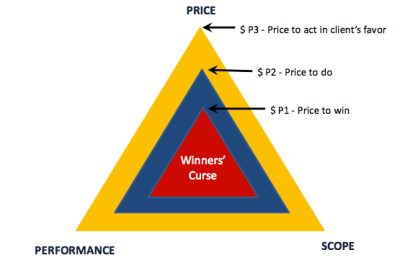
To better understand what happened, we have to look at the concept of the Iron Triangle (picture above).

The Iron Triangle reflects the basic three elements of a successful deal. These are:

  1. Scope – what the products / services are.
  2. Performance (Quality) – what standards are required for the products / services
  3. Price – what price will be paid for the products / services

Focusing on the Price levels for now, this concept depicts three different price levels with the analogous levels of Scope and Performance (Quality).

1. The Winner’s Curse – This is the price a bidder will bid in order to win a tender. (P1)

2. Price to do – This is the price required to do the job including a reasonable margin (P2)

3. Price to act in Customer’s favor – The highest bid of all which corresponds to the highest quality and scope (considered in Customer’s favor) (P3).

In the above example, what the IT department (the Customer) failed to understand is, that selecting the vendors based on the P1 price level (the Winner’s Curse) means that the Provider needed to cut corners to recover its cost and potentially make a margin.

On the other hand, the expectation the Customer has in terms of Performance (Quality) and Scope usually resembles the corners of the Triangle corresponding to price level P3.

This means that the eventual triangle the Customer would require consists of the highest Quality and Scope levels but the lowest price. This results in a skewed triangle and is unsustainable.

Hence, what ensued the deal in the above example was the breakdown of the relationship and the spiraling of costs.

So, reflecting on the Iron Triangle, sourcing should be a search for the best value for money deal, taking into account the Scope, the Performance and the Price from the start.

TIPS TO AVOID BEEN CAUGHT IN THE WINNER’S CURSE

So, what are some tips to avoid been caught in the Winner’s Curse?

  • Be informed about what you want (specifications), how you want it delivered (quality), what value-additions are required (if any).
  •  Be in the know, from a Total Cost of Ownership (TCO) perspective e.g. estimate the transition costs for changing suppliers (should you want to add them in the mix) etc
  • A deal made must include clarity around these three items Scope, Quality and Price. Be sure to cover all of those from the start.
  • Have a variation process agreed.
  • Have an exit strategy should things go wrong.
  • Know the triangle you are in at every deal and prepare for any shortcomings if in fact you are forced to go for a winner’s curse.

Do you know what triangle you were part of the last time you did a deal?

Image courtesy of Sara Cullen / www.whiteplumepublishing.com