The Leader’s role in setting and keeping the tune!

Recently, Julian Barson posted an interesting remark about the changing nature of business and the role of leadership (post can be found here).

I have posted before about Leadership (here) in the form of a jungle story. Reflecting on Julian’s remarks I believe that there may be another way to think of a leader though.
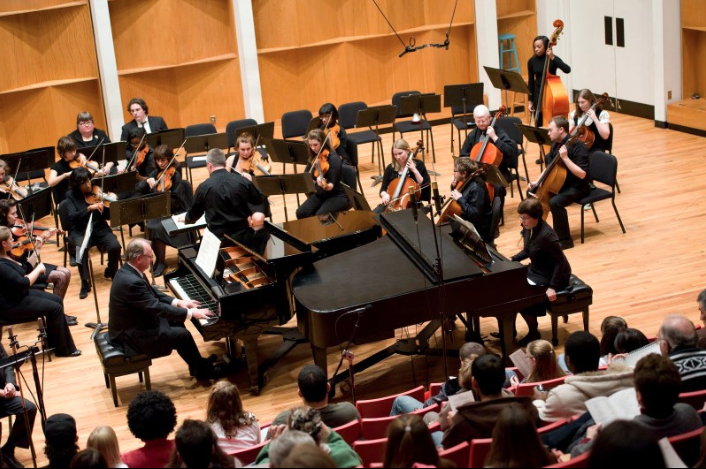
East Stroudsburg University

Leadership has been resembled by some to conducting an orchestra in terms of conducting a well tuned symphony. I think this is a good start but not the whole story. We should remember that

Excellent pre-work is what ensures the successful performance.

THE SUCCESSFUL ORCHESTRA

Imagine a very prolific conductor of an orchestra who is also the executive producer. She has the passion required, a limited budget and the whole genre of music to choose from, whilst she is operating in a rapidly-changing hypercompetitive environment.

Starting with a vision of where the orchestra should go towards (the so called, True North), putting a competent team together, setting the goals, selecting the orchestra’s target market (which involves the musical genre and particular segmentation and selection), identifying the value proposition and communication channels including frequency and style and ensuring that the “product” is differentiated enough to attract audiences as well as, ensuring that the resources available are best utilised and lobbying is performed for acquiring new resources are, only the start.

Then, the conductor/producer needs to select the orchestra instruments, the right orchestra performers, position them right, select the compositions to be performed, select the venues, the style of music, the time of the performance, keep the orchestra attuned and also get the orchestra to set its own tune.

Setting your own tune

Discussing music, the orchestra’s journey of setting its own tune is a big challenge as, unless there is some kind of familiarity the audiences may not attend.

It is thus worthwhile remembering that:

“We enjoy the familiarity of old tunes as we comfort in the security of the subsequent verse”

On the other hand though, the conductor needs to surpass this familiarity by differentiating the orchestra’s value proposition enough, to keep the audience captivated.

Perform and Delight

And as the saying goes “you are as good as your last performance”.

So, the pressure is on and the expectations need to be set high for audiences to attend. And then, expectations need to be met and hopefully exceeded, creating the much required sense of delight to the audience so that, these come back for more next time.

Continually adhering to these principles means that the conductor will lead the orchestra to success.

Examples

A great example of differentiation, as well as, transformation of a whole industry is, the paradigm of Cirque de Soleil, (you can read more in the now classic book “Blue Ocean Strategy” by Kim and Mauborgne) (a snapshot can be found here).

As Hubbard et al. detailed in another great book titled “The First XI” the “attunement” or alignment of key elements in an organisation is a key for organisational success.

Specifically,

“Alignment of External Environment, Strategy, Capabilities, Culture, Systems, People, Leadership, Structure, Communication, Perceptions” is a key to a winning organisation. – The First XI: Winning organisations in Australia. Hubbard et al.

ORCHESTRA OF ONE

A final note to consider.

Each of us can and should choose our own tune to orchestrate. A fantastic initiative from the Melbourne Symphony Orchestra highlights this point. Enjoy the video below:

Each of us can and should aim to be an orchestra of one. Remember in an orchestra the conductor is the Leader but for example, you also have a lead violin and you can have solo performances equally captivating (see Zoe Keating’s one woman cello band).

As the saying goes said:

Life is not to be spend on the spectator’s seat, get on stage.

It is important to aim to Lead something of importance to us. And if we are in such a position to enable others to become leaders themselves (see here, here and here my posts on team engagement and enablement).

I do believe that the successful companies of tomorrow will be companies of Leaders. Each employee should aim to become a leader on a particular field and will be enabled by a Leader/Conductor who will be setting the tune.

What have you Lead lately?

[Image courtesy of East Stroudsburg University / www.flickr.com]

What can a jungle story teach us about leadership?

Leadership is one of these words which, when you ask someone to define it, you usually get a vague answer or a platitude.

This is because people feel what Leadership is when it is present but otherwise, they find it very hard to describe it in words.

In such complex subjects I have found that storytelling has much to offer.

Drriss & Marrionn

A compelling story about leadership comes from Stephen covey’s classic book The 7 Habits of Highly Effective People.

If you have not read the book, it certainly has much to offer. If you have read the book, I am sure you will enjoy remembering this excerpt as much as I do.

STEPHEN COVEY ON THE DIFFERENCE BETWEEN LEADERSHIP AND MANAGEMENT

The story goes like this:

You can quickly grasp the important difference between the two if you envision a group of producers cutting their way trough the jungle with machetes. They’re the producers, the problem solvers. They’re cutting through the undergrowth, clearing it out.

The managers are behind them, sharpening their machetes, writing policy and procedure manuals, holding muscle development programs, bringing in improved technologies and setting up working schedules and compensation programs for machete wielders.

The leader is the one who climbs the tallest tree, surveys the entire situation, and yells, “Wrong jungle!”

But how do the busy, efficient producers and managers often respond? “Shut up! We’re making progress.”


I find this an excellent example of what the difference of management and leadership is all about. The story is both thought-provoking and self-explanatory.

So, next time anyone asks you “how would you describe leadership” maybe you can tell them a jungle story about the leader that both knew where the team was supposed to be and had the courage to cry “Wrong jungle!”

What is your leadership story?

[Image courtesy of Drriss & Marrionn / www.flickr.com]

How to eat an elephant?

Most of the projects that can make a difference in today’s world are big, complex, risky and generally prone to failure.

How does one counter this uncertainty and maintain a steady course?

Firstly, ask the right questions!

“Asking the right question is half the answer” Aristotle

Then, set your goal – your True North – and persevere in staying the course!

As Thomas Edison, a great prolific inventor, once said:

“I have not failed. I’ve just found 10,000 ways that won’t work.” Thomas Edison

What Edison suggests is that perseverance and hard work eventually pays off. He has 1,093 US patents to prove it.

Along the same lines, I have found the below story from the Jim Collins inspiring and tremendously helpful in keeping me focused when dealing with complex, big projects:

The 20-Mile March from Book Great by Choice by Jim Collins

Amundsen vs. Scott – Conquering the South Pole:

The round trip trek was roughly fourteen hundred miles, the equivalent of the distance from New York to Chicago and back.The environment was uncertain and unforgiving, where temperatures could easily reach 20 degrees below zero F even during the Summer.They had no means of modern communications – no cell phones, no satellite links, no radio – a rescue would have been improbable were they to err.One leader led his team to victory and safety.The other led his team to defeat and death.

Throughout the journey, Amundsen adhered to a regimen of consistent progress, never going too far in good weather, careful to stay away from the red line of exhaustion that could leave his team exposed, yet pressing ahead in nasty weather to stay on pace.Amundsen throttled back his well-tuned team to travel between 15 and 20 miles per day, in a relentless march to 90 degrees south.When a member of Amundsen’s team suggested they could go faster, up to 25 miles a day, Amundsen said no.They needed to rest and sleep so as to continually replenish their energy.In contrast, Scott would sometimes drive his team to exhaustion on good days and then sit in his tent and complain about the weather on bad days.At one point Scott faced 6 days of gale force winds and traveled on none, whereas Amundsen faced 15 and traveled on 8.Amundsen clocked in at the South Pole right on his pre-decided pace, having averaged 15.5 miles per day.Scott in contrast fell behind early, with no plan of a daily pace, and as the conditions worsened, enhanced by his lack of preparation for unforeseen events, he and his team never recovered.


There are countless times I have used this technique to tackle the most daunting of tasks.

The key is to set a constant and keep on it without thinking about the total. Before you know it you are there and most importantly you have enjoyed the journey!!!

e.g. I remember I needed to go over a textbook of 1000 pages. Reading 1000 pages is daunting but breaking down the task and focusing on disciplined reading of 30 pages a day made the task achievable and easy to tackle. A friend has used the same technique to run a marathon. There are a variety of examples if you think about it.

Remember,

“A journey of a thousand miles begins with a single step”. Lao Tzu


So, as the saying goes: How to eat an elephant?

– A bite at a time!


Do you have a 20-mile March task you have been putting off for a while? Now, may be a good time to start.

Happy Marching!


[Image credit: 123rf.com]