The 9 Elements of an Effective Team (Part 1)

What are the building elements and structure of effective teams?

Teams have varying demands bestowed upon them in terms of efficiently doing the pre-allocated work but also maximising contribution to the organisation and keeping up to speed with varying business needs. Different business environments have different team structures that work for them e.g. self-organising, rigidly structured, matrix, adhoc. There are though some elements that every team should possess in order to be effective. Let’s see what these may be.

3199990-small-group-of-business-people-joining-hands-low-angle-view

ELEMENTS OF AN EFFECTIVE TEAM

The elements that are crucial for the well being but also the smooth operation and success of a team can be summarized as follows:

1) Clear Goals

2) Good Team Structure

3) Right Culture and Skillset selection

4) Trust

5) Good Communication

6) Positive relationships

7) Accountability

8) Leadership

9) Feedback

1) Clear goals – Why does the team exist?

As I have alluded to (here), one of the key ingredients for success is the alignment of targets and culture between the Organisation, the business unit and each individual team.

Imagine the Organisation as a rowing boat with each individual rower (representing business units or teams) being misaligned with the organisational targets and rowing out of sync. The boat will make very little progress if at all even if it manages to make some headway.

Now, imagine the same boat with each team, business unit in full alignment with the organisational goals and rhythm. That is how champion teams operate (this analogy comes from Ram Charan‘s book “What the CEO Wants You to Know”).

2) Good Team structure

As I mentioned above the teams in today’s world come in many shapes and forms e.g. project teams are common nowadays.

Hence, ensuring that the right departments are involved in the formation of the project team and formulating a team structure that compliments the expected outcomes is of the essence.

e.g.  when putting together a team with a creative target then having a design that is autocratic, rigidly hierarchical does not promote open communication of ideas between all members and will most likely not produce or heavily delays a good result.

3) The Right Culture and Skillset Selection – Identification and selection of the right culture of people and skillets that compliment each other and can work to the maximum benefit of the company.

This is an expansion to element number 2 noted above e.g. knowing that IT, Finance, Sales and Procurement need to be involved is one thing. Selecting the right people from within these departments is another. Usually, Projects teams need to have within them a wide selection of influencers in order to be effective.

e.g. discussing Project teams, it is important that members of the team include i) someone that can get buy in from Top Management (usually an executive leader), ii) someone with experience in the project field who can ensure that pitfalls are avoided and the  scope and available options can be fully explored and articulated and finally, iii) someone who has the relationship power to engage and get buy in from outside teams and departments.

4) Building a culture of Trust.

● Trust is a sine qua non for any effective relationship. Without it communication falls short of any meaningful exchange of ideas as time usually is taken up on resolving conflict and misunderstandings.

A couple of simple tips to build trust is:

● Do what you say you will.

● Be honest and embrace open communication.

At next week’s post (Part 2), I will discuss the remainder of the elements 5 to 9.


[Image credit: 123rf.com]
How can you measure Employee Satisfaction using an NPS® survey?

So, you are leading a great Organisation, a great division, you are a great manager, supervisor, team leader, you are funny and everybody wants to work with you. You provide feedback, your employee retention rate is high, your team loves you and other departments look forward to the opportunity of collaborating with your team.

That is a common way to believe about ourselves and our teams. But is there a way to quantify this feel-good notion and see if there are gaps we could improve on. To see if, at the end of the day, our notion holds true?

One way of testing this notion is by modifying a common survey metric used extensively for measuring customer loyalty and customer satisfaction. The NPS® (Net promoter Score) survey.

I did this by using a common method for innovation I blogged about here and here (i.e. SCAMPER).

NPS® (Net promoter Score)- for Organisations

The concept of the Net Promoter Survey was introduced by Fred Reichheld in his Harvard Business Review article called “The One Number You Need to Grow”.

A simple definition is this:

Net Promoter is a management tool that can be used to gauge the loyalty of a firm’s customer relationships. (Wikipedia)

The concept is simple because it is based on one question that is easy to answer and pretty straightforward.

For an Organisation the NPS®® question is:

How likely is it that you would recommend our company to a friend or colleague?

An quick recap of the method can be found below:

  1. Ask the question to a sample base (key customers, account managers etc). The greater the sample base the more accurate the results.
  2. Collect the data and establish percentages for below categories.

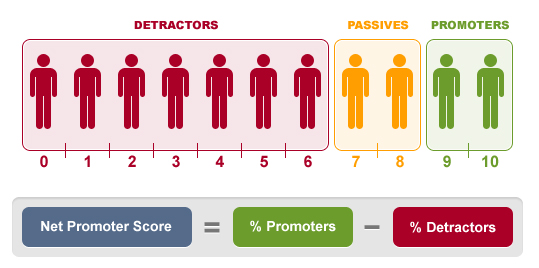
          i). Percentage that answered 1-6 (these are considered detractors)
         ii) Percentage that answered 7-8 (these are considered passives)
        iii) Percentage that answered 9-10 (these are considered promoters)

Then deduct (the % score that answered 9 or 10) from (the % score that answered 1 to 6). The outcome is your Net Promoter Score. See below illustration for easier reference.

Net Promoter Score (checkmarket.com)

You can then compare it to an industry benchmark or establish a trend of how your NPS® trends over time.

Of course, just asking the question and getting a good or a bad result is one thing. Understanding of why you are getting such a score is another.

So, the NPS® question should be followed or accompanied by a more comprehensive customer survey. Additionally, having a customer relationship journal (CRM systems) capturing customer feedback and constantly reassessing what the customers really value or find worth paying for, assists in influencing your decisions and thus, improving the next NPS® result.

Modified for use within Teams

For team members or employees in general the question can be modified as follows:

Considering your experience working for [insert team or company name], would you recommend to others to join [insert team or company name] when a position becomes available?

Modified for use within Teams

For a team the question can be modified as follows:

Considering your complete experience with the [insert name of team], how satisfied are you with the products and services that the [insert name of team] provides?

Necessary Caveat

There is a caveat. IF you are unwilling to change your ways based on the feedback provided or don’t intend to keep an open mind, THEN these surveys and feedback sessions can, and most probably will, do more harm than good.

This is because people will not trust that you genuinely want their input and so, will either not provide genuine feedback or avoid participating altogether (in both these situations you lose).

At next posts we will see two practical ways of getting specific feedback from your team/ employees so, from an informed position, you can influence the NPS® score.

So, what is your NPS® score? Is this what you envisaged?

[Image credit: 123rf.com]

Employee Engagement: 3 Essential Targets (Part 3)

Previously, I examined of the Why and the So What we should forget trying to motivate staff and instead focus on employee engagement.

Let’s now have a look at 3 essential elements you should focus on and some practical examples on HOW to go about it.

HOW

As I argued previously there is a direct link between employee engagement and employee contribution. This link expands to include job satisfaction. Hence, in seeing how we can best engage employees I suggest we look first at the elements of job satisfaction.

There are various models that assist in exploring Job Satisfaction. One of the most useful ones I have found comes from Malcolm Gladwell.

It has three parts:

“Those three things – autonomy, complexity, and a connection between effort and reward – are, most people will agree, the three qualities that work has to have if it is to be satisfying.” — Malcolm Gladwell (Outliers)

So, for work to have this “enjoyment-based intrinsic motivation, [which] is the strongest and most pervasive drive” (Daniel Pink, Drive) we need to focus on these three things:


AUTONOMY

Autonomy does not need to mean working solo. In essence, everyone reports to someone else. However, for the parts that you can you should provide relative autonomy to the team members.

It is thus important to first agree on the Purpose, the expected result and the framework instead of the method. Then, as a manager, supervisor, team leader or fellow team member focus on providing support, guidance and feedback.

e.g. with my team we have developed a system whereas, each team member can select a pet project (a product) to work on for a number of weeks and then present to the team. The caveat is that the product is one that when delivered will have a perceived value to the team and that it is aligned with our team’s mission. Then each team member has the autonomy to work within the framework towards the agreed goal. Many great improvements to our processes and ways of thinking have come from this initiative.

This is one way to promote autonomy within the team.

Another simple way is based on the motto:

“Don’t report a problem, recommend a solution”.

e.g. team member is expected to formulate their communication so that if there is an issue the focus is on the recommended ways of overcoming it as well as reporting it rather than merely reporting. This is another way to promote autonomy.

COMPLEXITY

Dealing with this concept, I often hear the argument “I cannot make this job interesting. It involves one repetitive task and it requires very low skill level”.

It appears that, for some, some positions are perceived “boring” by definition. This view though does not assist in keeping employee retention levels high. It also creates substandard realities for people who can certainly offer more if given a chance.

What can be done about it?

Try asking the questions:

  • Can the mix of work change?
  • Is there a Continuous Improvement Project that the team member can engage in on the side?
  • Is there a better way to do this?
  • If the job does not require much skill and is repetitive why is it not automated? That’s a meaningful project in itself.
  • Are there strengths the team member has which can be useful on other projects within the Organisation?

LINK BETWEEN EFFORT AND REWARD

This is another point that has drawn much discussion. Do we focus on carrots or sticks.

Provided that the hiring process have delivered well suited team members to the requirements of the positions, I firmly believe that the daily interactions should be based on creating positive relationships. Hence, maximizing each team members’ strengths.

This is best done by rewarding positive behaviors and contributions as well as, working with the team to correct any behaviors and outcomes that do not contribute to the team success.

Rewards, of course, need to be customised to the character and what “talks to each individual”. In saying this, there is one need that is perceived to be universal.

“The deepest principle in human nature is the craving to be appreciated.” William James

Here are some practical ways to reward effort and stimulate contribution:

1) Feedback

i) A productive way to do this is to start feedback loops as standard daily practices. A structured way to provide feedback can be found here and here.

Promoting such interactions and providing ways to go about many benefits including better bond between the team members, less frustration from each others behaviours as frustrations are positively verbalised and others.

ii) Another way to approach feedback is by performing a SWOT analysis for the team involving the whole team. A recap of how this can be done can be seen here.

2) Boost Organisational Conversation

Boris Groysberg and Michael Slind in a recent article in HBR provide some insight on the use of an element that is part of a new model of leadership. The element of organizational conversation and conclude that:

“For an inclusive leader, the term “employee communication” takes on a provocative new meaning. For generations, that term has referred to communication aimed at employees. Today, by contrast, more and more leaders are seeking ways to leverage the value of communication performed by employees”

Examples of how to do so can be found here.

3) Celebrate Successes

Allow each month for the team to reflect on the performance and projects and put forward examples of their success e.g. what each member considers the biggest success of the month. This contributes to understanding each other better and what each perceives as success. The Successful stories can also be used as a form of cross training if a quick presentation is given on these projects to the team.

Another example: As mentioned before our team has developed a system of “products” within our team that each team member can work on as a pet project for 8 weeks. At the end of 3 such sessions, every six months, we all vote deciding on the one “product” that contributed the most in our development as a team. The person that is issued a certificate acknowledging their good work.

Lot of benefits have flowed from these initiatives and hence, I wholeheartedly recommend them.

So, what are the ways you engage your team? 

[Image credit: 123rf.com]

Don’t try to Motivate your team, Employee Engagement is what matters: So What (Part 2)

In the previous blog I discussed why we should forget trying to motivate staff and instead focus on employee engagement. Let’s now have a look at why this is important.

SO WHAT?

In approaching this theme, we have to first reflect on what Paul Rogers would normally ask “So, what?”

The answer to this question relies on a simple logical sequence:

Employee Engagement –> Trust –> Effective Work –> Contribution –> Customer Success –> Perpetuation of the Organisation

A) EMPLOYEE ENGAGEMENT BUILDS TRUST.

Trust is a basic ingredient of any positive relationship. If Trust is missing then teamwork does not exist. This is because cooperation and daily interaction easily deteriorates into arguments and conflict which is destructive for the morale of a team and diverts their attention from the real targets.

Hence, the existence of Trust is the building stone for the team members doing effective work and contributing to the team.

B) EFFECTIVE WORK MEANS FOCUS IN PERPETUATING THE ORGANISATION

As I will discuss in a future blog post, employee contribution is a key element to achieve Customer Success.

This seems self-evident i.e unless employees truly care and try to excel in the delivery of their work and the advancement of the Organisation’s vision and targets (provided of course that the Organisation’s positioning is rightly adjusted), the Organisation will not succeed in its goals and hence, its customers will be less likely to be successful in theirs.

On a broader scale, Drucker’s vision takes a more existentialist view on what an organisation is there for:

An “Organization is, to a large extent, a means of over-coming the limitations mortality sets to what any one man can contribute. An organization that is not capable of perpetuating itself has failed…….. An organization which just perpetuates today’s level of vision, excellence, and accomplishment has lost the capacity to adapt. And since the one and only thing certain in human affairs is change, it will not be capable of survival in a changed tomorrow.” Peter Drucker from The Effective Executive.

So, for Drucker the organisation is a means for individuals to make a lasting contribution to the world.

From that perspective it is not only a necessity for an organisation to put in place a framework that ensures employee engagement so that employees can maximise their contributions and thus, secure the organisation remains relevant and profitable in this fast-paced world. But a responsibility to secure a framework that allows its employees and in extension itself to maximise its contribution to society overall.

In essence, looking at the grander picture i.e. that the Organisation is the lever for expression and progress in modern society or not, one thing is for sure: the success of the organizational goals is heavily reliant on employee engagement and contribution.

In my next blog post I will discuss some practical ways to achieve this.

[Image credit: 123rf.com]