4 techniques to help you get over the “Perfection Syndrome”

“Don’t let perfect be the enemy of the good” – Mark and Mike (Manager Tools).

How many times have you hesitated to ship a project, verbalise an idea, start on a venture, make a phone call because you considered your preparation to be less than perfect?

This is a very common situation I like to call the Perfection Syndrome. It can be quite debilitating as it does not allow individuals and teams to be creative and effective in the workplace to their full potential.

Read this post if you want to find out 4 techniques that can make these dilemmas go away and put your mind at ease so you can press send, speak up or make a first step next time.

DSC_6744

TECHNIQUES FOR OVERCOMING THE PERFECTION SYNDROME

Let’s look at the four such techniques:

1. Treat everything as a DRAFT and declare them as such.

Simply watermark DRAFT as the background or mention it when you are presenting.

This simple technique communicates the fact that you are open to ideas and feedback and allows you to

i) start the conversation with those around you

ii) create the perfect environment for collaboration.

Now, the pressure is off as Drafts are meant to be imperfect and everyone understands this.

2. Have the important stuff CURATED.

Simply have another set of eyes go through the detail to pick any errors or enhance the presentation, content, style etc.

As an example, in our team we are using each other as an Email Curator. This means that, especially when the stakes are high, emails are scanned for content, purpose, readability by the writer and another team member.

In this way everyone has a better idea of what everyone else is working on and as a result of this process the important emails or projects look and feel much more professional upon submission.

3. Make a list of different versions of things that you previously considered good enough or “perfect” and use them selectively in the future.

For example, if you perceive contracts as jigsaw puzzles where the best elements for each need to be combined and fit for purpose, then having available variations of clauses or Ideas (variations that have been audited, approved and used previously), then you will be never “lost for words”.

These variations provide options so each Contract is fit for purpose.

The alternative would be to use a standardised template which will most likely NOT be the best fit for the purpose and confine our thinking. This is because the scope, quality, governance etc you aim for with each vendor is different.

Don’t get me wrong, some elements of a Contract can certainly be templated (e.g. Legal section including Insurance, Formal Disputes Resolution etc) but others are better not (e.g. SLAs, Governance, Relationship, Work Practices).

An even worse alternative to using a rigid standardised template would be to start each time from a blank page. This is simply counter-productive.

4. Have a Checklist to ensure everything gets covered.

For example, each contract should cover some key minimum sections e.g. the 3Ps – Parties, Price and Product and then a variety of others (e.g. SLA, Governance, Termination, Work Practices, Code of Conduct etc).

Having a checklist ensures that all aspects that need to be covered or discussed are covered one way or another.

These are just 4 techniques you can use as enablers to get over the “Perfection Syndrome”.

Do you use any others?


[Image courtesy of jpkwitter / http://mrg.bz/Y18YBz]
If you want something complex done well, give it to a busy person!

We have all heard the phrase “If you want something done, give it to a busy person”. We all felt that there is some truth in it.

Research done by Dijksterhuis and van Olden recently seems to take this insight to another level.

The research was performed on how Decision Making and the likelihood of  Regret are linked and produces some very interesting results. Let’s look into it.

THE EXPERIMENT

As mentioned in Richard Wiseman’s book 59 Seconds, a few years ago Dijksterhuis and van Olden conducted a study whereas, subjects were shown five posters and were asked to use three different techniques to make a decision. At the end of this process the subjects were given the poster of their choice and a month later the researchers called them and asked them how they felt about their decision and what amount of money would it take to part with their originally chosen poster. The results are surprising.

At the time of the experiment the researchers broke the subjects into three groups.

  1. The first group was asked to immediately choose the poster they liked the most.
  2. The second group was asked to study the posters well, list what they liked and did not like about them. Only then, to make a decision and choose a  poster.
  3. The third group was quickly shown the posters and then they were asked to do anagram puzzles for 5 minutes. Only after this process, they were asked to choose a poster.

At the end of the experiment, all subjects from all three groups were handed over the poster of their choice, and then a month later they were asked how much they liked the poster then and how much they would sell it for.

Surprisingly, at the time of the experiment the subjects in Group number 2 (the ones that were asked to carefully consider the pros and cons) were the most confident they had made the right decision.

A month later though, it was a completely different story.

Group number 3, (who was shown the posters quickly and then did puzzles before eventually making a choice), were the most attached to their chosen poster and wanted more money to part with it.

WHY GROUP NUMBER 3? THE THEORY OF THE UNCONSCIOUS THOUGHT

The explanation of this behaviour is attributed to what is called, the theory of the Unconscious Thought.

A good summary of it can be found here and below.

Unconscious thought theory (UTT) was first presented by Ap Dijksterhuis and Loran Nordgren in 2006. UTT posits that the unconscious mind is capable of performing tasks outside of one’s awareness, and that unconscious thought (UT) is better at solving complex tasks, where many variables are considered, than conscious thought (CT), but is outperformed by conscious thought in tasks with fewer variables. This is a countercurrent position, as most research on UT since the early 1980s has led to its being characterized as simple and incapable of complex operations. Dijksterhuis’ and Nordgren’s theory is based primarily on recent findings from a new experimental paradigms.

The interesting article, titled, The Beautiful Powers of Unconscious Thought by Dijksterhuis himself (here), elaborates on the facts and nuances of these important findings.

PUTTING THEORY IN PRACTICE

So, what does this mean in practice for everyday work life?

Well, I think that this data supports the position that managers, supervisors and organisations need to make an effort to fill the days of their teams with meaningful projects and try to engage them (ideas on how to do this can be found here and well as a method on innovation here and here).

Moreover, as mentioned here we have to move one step forward from being busy to becoming productive as, the key question is not if we are “doing” something but if we are “effective” in what we aim for.

Hence, the organisations need to create an environment conducive to best utilise the theory of the Unconscious Thought aiming of course the more complex of projects. I trust that more research will be done on these important findings in the future that will verify and expand our understanding in this important field.

How did you handle your last complex task allocation?

Image of Ap Dijksterhuis courtesy of Radboud University Nijmegen / www.ru.nl

The Leader’s role in setting and keeping the tune!

Recently, Julian Barson posted an interesting remark about the changing nature of business and the role of leadership (post can be found here).

I have posted before about Leadership (here) in the form of a jungle story. Reflecting on Julian’s remarks I believe that there may be another way to think of a leader though.

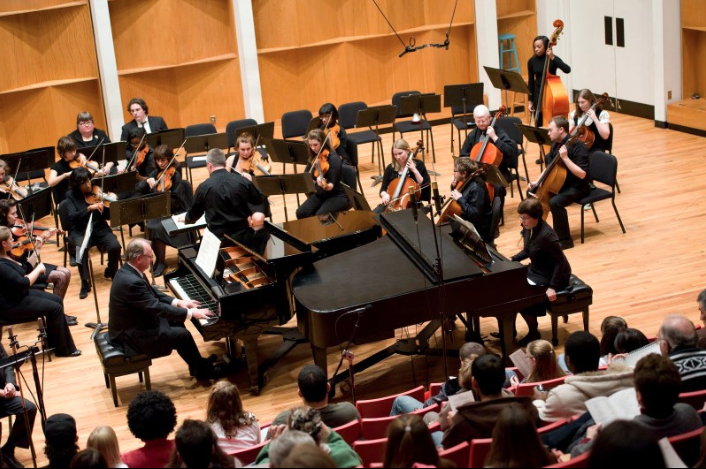
East Stroudsburg University

Leadership has been resembled by some to conducting an orchestra in terms of conducting a well tuned symphony. I think this is a good start but not the whole story. We should remember that

Excellent pre-work is what ensures the successful performance.

THE SUCCESSFUL ORCHESTRA

Imagine a very prolific conductor of an orchestra who is also the executive producer. She has the passion required, a limited budget and the whole genre of music to choose from, whilst she is operating in a rapidly-changing hypercompetitive environment.

Starting with a vision of where the orchestra should go towards (the so called, True North), putting a competent team together, setting the goals, selecting the orchestra’s target market (which involves the musical genre and particular segmentation and selection), identifying the value proposition and communication channels including frequency and style and ensuring that the “product” is differentiated enough to attract audiences as well as, ensuring that the resources available are best utilised and lobbying is performed for acquiring new resources are, only the start.

Then, the conductor/producer needs to select the orchestra instruments, the right orchestra performers, position them right, select the compositions to be performed, select the venues, the style of music, the time of the performance, keep the orchestra attuned and also get the orchestra to set its own tune.

Setting your own tune

Discussing music, the orchestra’s journey of setting its own tune is a big challenge as, unless there is some kind of familiarity the audiences may not attend.

It is thus worthwhile remembering that:

“We enjoy the familiarity of old tunes as we comfort in the security of the subsequent verse”

On the other hand though, the conductor needs to surpass this familiarity by differentiating the orchestra’s value proposition enough, to keep the audience captivated.

Perform and Delight

And as the saying goes “you are as good as your last performance”.

So, the pressure is on and the expectations need to be set high for audiences to attend. And then, expectations need to be met and hopefully exceeded, creating the much required sense of delight to the audience so that, these come back for more next time.

Continually adhering to these principles means that the conductor will lead the orchestra to success.

Examples

A great example of differentiation, as well as, transformation of a whole industry is, the paradigm of Cirque de Soleil, (you can read more in the now classic book “Blue Ocean Strategy” by Kim and Mauborgne) (a snapshot can be found here).

As Hubbard et al. detailed in another great book titled “The First XI” the “attunement” or alignment of key elements in an organisation is a key for organisational success.

Specifically,

“Alignment of External Environment, Strategy, Capabilities, Culture, Systems, People, Leadership, Structure, Communication, Perceptions” is a key to a winning organisation. – The First XI: Winning organisations in Australia. Hubbard et al.

ORCHESTRA OF ONE

A final note to consider.

Each of us can and should choose our own tune to orchestrate. A fantastic initiative from the Melbourne Symphony Orchestra highlights this point. Enjoy the video below:

Each of us can and should aim to be an orchestra of one. Remember in an orchestra the conductor is the Leader but for example, you also have a lead violin and you can have solo performances equally captivating (see Zoe Keating’s one woman cello band).

As the saying goes said:

Life is not to be spend on the spectator’s seat, get on stage.

It is important to aim to Lead something of importance to us. And if we are in such a position to enable others to become leaders themselves (see here, here and here my posts on team engagement and enablement).

I do believe that the successful companies of tomorrow will be companies of Leaders. Each employee should aim to become a leader on a particular field and will be enabled by a Leader/Conductor who will be setting the tune.

What have you Lead lately?

[Image courtesy of East Stroudsburg University / www.flickr.com]

Employee Engagement: Practical Tips for a more productive culture in the workplace – Presentation

Thanks to the Chartered Institute of Logistics & Transport Australia (CILT Australia) for hosting my webinar “Employee Engagement: Practical Tips for a more productive culture in the workplace” on the 26th November 2013. The presentation was very well received and the feedback and questions I got afterwards were thought provoking. For those that missed it this is the presentation. Additionally, the sound recording can be accessed by CILT Australia members here.

BACK UP RESOURCES

This presentation was the culmination of various posts and years of work. If you want to revisit the Employee Engagement concepts in more depth you can read more here, here and here. The Productive Culture Survey background can be found here, details about NPS surveys here, thoughts on the basic qualities of a effective team member here and thoughts on the basic qualities of an effective team can be found here and here. Finally, if you wanted a simple guide on how to go about innovating, similarly to what I have done with various elements in this presentation, to suit your own individual needs read this simple method here and here.

WEBINAR BRIEF AS PUBLISHED BY CILT AUSTRALIA:

Event Description:
What is the difference between motivation and employee engagement?
In this presentation the view that employee engagement should be the preferred target will be analysed.

Why is employee engagement important?
Practical ways to assess the Productive Culture in the workplace will be discussed.

What is the link between employee engagement and job satisfaction? What are the elements that constitute job satisfaction?

Practical examples on how these elements can be further stimulated will also be in the offing as well as the opportunity to download free material that will assist you to assess the existent culture of your team and make your team more effective.

Guest Speaker:
George Vrakas (MBA, CMILT)