If you want something complex done well, give it to a busy person!

We have all heard the phrase “If you want something done, give it to a busy person”. We all felt that there is some truth in it.

Research done by Dijksterhuis and van Olden recently seems to take this insight to another level.

The research was performed on how Decision Making and the likelihood of  Regret are linked and produces some very interesting results. Let’s look into it.

THE EXPERIMENT

As mentioned in Richard Wiseman’s book 59 Seconds, a few years ago Dijksterhuis and van Olden conducted a study whereas, subjects were shown five posters and were asked to use three different techniques to make a decision. At the end of this process the subjects were given the poster of their choice and a month later the researchers called them and asked them how they felt about their decision and what amount of money would it take to part with their originally chosen poster. The results are surprising.

At the time of the experiment the researchers broke the subjects into three groups.

  1. The first group was asked to immediately choose the poster they liked the most.
  2. The second group was asked to study the posters well, list what they liked and did not like about them. Only then, to make a decision and choose a  poster.
  3. The third group was quickly shown the posters and then they were asked to do anagram puzzles for 5 minutes. Only after this process, they were asked to choose a poster.

At the end of the experiment, all subjects from all three groups were handed over the poster of their choice, and then a month later they were asked how much they liked the poster then and how much they would sell it for.

Surprisingly, at the time of the experiment the subjects in Group number 2 (the ones that were asked to carefully consider the pros and cons) were the most confident they had made the right decision.

A month later though, it was a completely different story.

Group number 3, (who was shown the posters quickly and then did puzzles before eventually making a choice), were the most attached to their chosen poster and wanted more money to part with it.

WHY GROUP NUMBER 3? THE THEORY OF THE UNCONSCIOUS THOUGHT

The explanation of this behaviour is attributed to what is called, the theory of the Unconscious Thought.

A good summary of it can be found here and below.

Unconscious thought theory (UTT) was first presented by Ap Dijksterhuis and Loran Nordgren in 2006. UTT posits that the unconscious mind is capable of performing tasks outside of one’s awareness, and that unconscious thought (UT) is better at solving complex tasks, where many variables are considered, than conscious thought (CT), but is outperformed by conscious thought in tasks with fewer variables. This is a countercurrent position, as most research on UT since the early 1980s has led to its being characterized as simple and incapable of complex operations. Dijksterhuis’ and Nordgren’s theory is based primarily on recent findings from a new experimental paradigms.

The interesting article, titled, The Beautiful Powers of Unconscious Thought by Dijksterhuis himself (here), elaborates on the facts and nuances of these important findings.

PUTTING THEORY IN PRACTICE

So, what does this mean in practice for everyday work life?

Well, I think that this data supports the position that managers, supervisors and organisations need to make an effort to fill the days of their teams with meaningful projects and try to engage them (ideas on how to do this can be found here and well as a method on innovation here and here).

Moreover, as mentioned here we have to move one step forward from being busy to becoming productive as, the key question is not if we are “doing” something but if we are “effective” in what we aim for.

Hence, the organisations need to create an environment conducive to best utilise the theory of the Unconscious Thought aiming of course the more complex of projects. I trust that more research will be done on these important findings in the future that will verify and expand our understanding in this important field.

How did you handle your last complex task allocation?

Image of Ap Dijksterhuis courtesy of Radboud University Nijmegen / www.ru.nl
The Leader’s role in setting and keeping the tune!

Recently, Julian Barson posted an interesting remark about the changing nature of business and the role of leadership (post can be found here).

I have posted before about Leadership (here) in the form of a jungle story. Reflecting on Julian’s remarks I believe that there may be another way to think of a leader though.

East Stroudsburg University

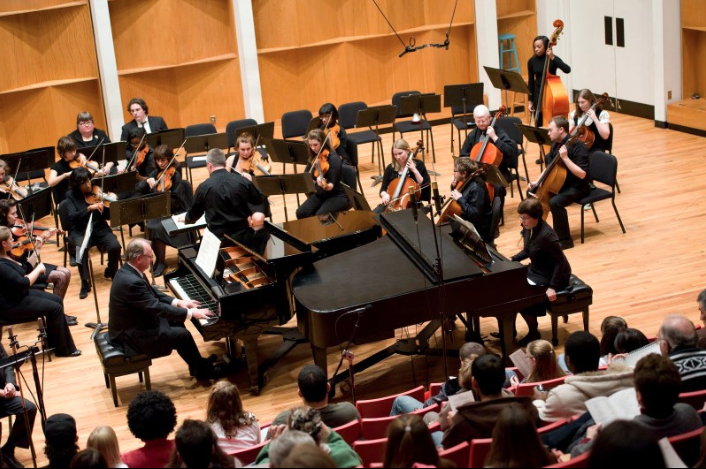
Leadership has been resembled by some to conducting an orchestra in terms of conducting a well tuned symphony. I think this is a good start but not the whole story. We should remember that

Excellent pre-work is what ensures the successful performance.

THE SUCCESSFUL ORCHESTRA

Imagine a very prolific conductor of an orchestra who is also the executive producer. She has the passion required, a limited budget and the whole genre of music to choose from, whilst she is operating in a rapidly-changing hypercompetitive environment.

Starting with a vision of where the orchestra should go towards (the so called, True North), putting a competent team together, setting the goals, selecting the orchestra’s target market (which involves the musical genre and particular segmentation and selection), identifying the value proposition and communication channels including frequency and style and ensuring that the “product” is differentiated enough to attract audiences as well as, ensuring that the resources available are best utilised and lobbying is performed for acquiring new resources are, only the start.

Then, the conductor/producer needs to select the orchestra instruments, the right orchestra performers, position them right, select the compositions to be performed, select the venues, the style of music, the time of the performance, keep the orchestra attuned and also get the orchestra to set its own tune.

Setting your own tune

Discussing music, the orchestra’s journey of setting its own tune is a big challenge as, unless there is some kind of familiarity the audiences may not attend.

It is thus worthwhile remembering that:

“We enjoy the familiarity of old tunes as we comfort in the security of the subsequent verse”

On the other hand though, the conductor needs to surpass this familiarity by differentiating the orchestra’s value proposition enough, to keep the audience captivated.

Perform and Delight

And as the saying goes “you are as good as your last performance”.

So, the pressure is on and the expectations need to be set high for audiences to attend. And then, expectations need to be met and hopefully exceeded, creating the much required sense of delight to the audience so that, these come back for more next time.

Continually adhering to these principles means that the conductor will lead the orchestra to success.

Examples

A great example of differentiation, as well as, transformation of a whole industry is, the paradigm of Cirque de Soleil, (you can read more in the now classic book “Blue Ocean Strategy” by Kim and Mauborgne) (a snapshot can be found here).

As Hubbard et al. detailed in another great book titled “The First XI” the “attunement” or alignment of key elements in an organisation is a key for organisational success.

Specifically,

“Alignment of External Environment, Strategy, Capabilities, Culture, Systems, People, Leadership, Structure, Communication, Perceptions” is a key to a winning organisation. – The First XI: Winning organisations in Australia. Hubbard et al.

ORCHESTRA OF ONE

A final note to consider.

Each of us can and should choose our own tune to orchestrate. A fantastic initiative from the Melbourne Symphony Orchestra highlights this point. Enjoy the video below:

Each of us can and should aim to be an orchestra of one. Remember in an orchestra the conductor is the Leader but for example, you also have a lead violin and you can have solo performances equally captivating (see Zoe Keating’s one woman cello band).

As the saying goes said:

Life is not to be spend on the spectator’s seat, get on stage.

It is important to aim to Lead something of importance to us. And if we are in such a position to enable others to become leaders themselves (see here, here and here my posts on team engagement and enablement).

I do believe that the successful companies of tomorrow will be companies of Leaders. Each employee should aim to become a leader on a particular field and will be enabled by a Leader/Conductor who will be setting the tune.

What have you Lead lately?

[Image courtesy of East Stroudsburg University / www.flickr.com]

“All models are wrong but some of them are useful”

This is my full article contribution as published in Procurement and Supply Australasia earlier this week.

There are times that we get so engrossed into the black and white way of thinking that we forget that life is far from having absolute truths.

George Box put this in a succinct way:

“Essentially, all models are wrong, but some are useful”.

                                              George E.P. Box (Statistician)

Math model

WHAT IS A MODEL?

A model is a particular way of interpreting the world. A great definition can be found here:

“A representation of a system that allows for investigation of the properties of the system and, in some cases, prediction of future outcomes”.

We have been using modelling since times immemorial as, it is our means of understanding the world. Models have always superseded older versions or worked alongside each other satisfying different targets.

e.g. Isaac Newton had conceived a very elegant model of understanding the cosmos which worked very well until it was superseded by Einstein’s (see here for details).

Well, it happens to the best of us.

PROCUREMENT AND GEORGE

George Box’s quote above is relevant to any discipline.

Specifically, in Procurement we have many models we are working with: RFP, RFQ,RFI, Krajlic, ROSNA, Pareto, ABC and the list goes on. But, there is not one of these though that can apply to all situations.

As an example consider this:

If the requirement is to simply get the best price e.g. for commoditized products in fragmented supplier markets, then a strong candidate to use as a model is an RFQ tender.

The RFQ model though is not working for e.g. high spend/high risk categories. That is where you would want the supplier to invest in the relationship and collaborate achieving innovative customer solutions as you are probably also targeting new product development.

Especially when in today’s world the battle is between Supply Chains and not organizations in isolation, strategic alliances are becoming key differentiators for organizational success. RFQs as well as other transactional Procurement techniques do not work for developing such relationships.

I know that we all have personal favourites.

Models that may have produced great successes in the past. So, deep inside we tend to give these models more credit than they deserve.

The important thing here is to recognize every model for what it truly is i.e. just one more tool in our toolbox to choose from and use.

Reading, discussing with colleagues, experimenting,continuously learning allows you to expand your toolbox enabling yourself and your organization to choose wisely the right model for your next procurement project.

So, when on your new procurement project remember dear old George and spend time in choosing the right model for your targeted outcome, because:

“All models are wrong but some of them are useful”.


[Image courtesy of fdecomite / flickr.com]

12 Essential Tools to maximise Productivity, Profitability, Employee Retention and Customer Satisfaction!

In previous posts (here and here) I explained how by using the concept of (Net Promoter Score) NPS you can establish  whether your notion of running a great Team / Organisation can be measured by this simple feedback loop.

But, how can you tell which areas you need to improve on when your internal NPS score is low?

Let’s look at a simple and practical method to do just that.

East Stroudsburg University

THE METHOD

The method I am suggesting is a simple 12 questions survey as detailed in Marcus Buckingham‘s books, “First Break All the Rules” and “Now, Discover Your Strengths”.

The survey was developed by the Gallup Organisation after their 25 year study of more than 1 million employees and 2,500 business units. What they found was a strong correlation between positive answers to this 12 question survey questionnaire and the below key business outcomes:

  • Productivity
  • Profitability
  • Employee retention and
  • Customer Satisfaction

THE GALLUP ORGANIZATION’S 12 QUESTION SURVEY:

    1. Do I know what is expected of me at work?
    2. Do I have the materials to do my work properly?
    3. At work, do I have the opportunity to do what I do best every day?
    4. In the last seven days, have I received recognition or praise for good work?
    5. Does my supervisor or someone at work seem to care for me as a person?
    6. Is there someone at work who encourages my development?
    7. At work, do my opinions seem to count?
    8. Does the mission of my company/department make me feel like my work is important?
    9. Are my coworkers committed to doing quality work?
    10. Do I have a best friend at work?
    11. In the last six months have I talked with someone about my progress?
    12. This last year, have I had opportunities at work to learn and grow?

                                                                                                   Marcus Buckingham, First Break all the Rules

QUESTION CLUSTERS

As you have probably distinguished the above 12 questions form 4 distinct clusters:

  1. Questions 1 and 2 -> “What do I get as an employee?”
  2. Questions 3 to 6 -> “What do I give as an employee?”
  3. Questions 7 to 10 -> “Am I in the right place to make the greatest possible contribution?”
  4. Questions 11 and 12 –> “How can we all give as a group?”

NECESSARY CAVEAT:

As with any such survey, running a productive culture survey means that you have established trust within your Team so that the survey outcomes are useful.

The survey can be run anonymously. This is recommended especially, the first time you run it as this can be used as a benchmark.

Thereafter and provided that you have worked on overcoming any trust issues, it is recommended to seek eponymous feedback so, you can discuss specifics with the respondents afterwards.


[Image courtesy of East Stroudsburg University / www.flickr.com]