The Iron Triangle – A great tool for successful Procurement and Contract Management

How do you distinguish if you pay too much? What are the elements you need to have in mind when putting together a deal?

There may be a lot of books and literature that describes this point. Nothing I have found though, makes this clearer than the concept of the Iron Triangle.

The Iron Triangle was part of a presentation by Sara Cullen at an IACCM workshop in Melbourne last year (you can find this concept in her book Outsourcing: All you need to know).

After hearing about this concept, I found that I was using it in discussions with colleagues more and more and that it was very useful to clarify situations and issues.

So, I thought I’d share it with you along with some tips on how to avoid been caught in what is called the “Winner’s Curse”.
Screen Shot 2014-02-13 at 9.43.15 pm

THE EXAMPLE

Sara, in her book, mentions the example of a retailer’s IT department (the Customer) who chose to go to tender for the data centre operations placing big emphasis on the price, on the belief that the services and the providers themselves were undifferentiated. So, the lowest bid (30% below the second lowest) won the tender. Value for money was not assessed or thought it was of importance.

Very quickly in the deal though, scope and price variations became the norm. KPIs were not achieved as these had been set up as targets and not as minimum standards and the Customer had not dedicated time to develop an SLA that was customised to the Customer’s needs.

Additionally, the Customer had now to dedicate a full resource to variation management. Demand peaks had not been accounted for within the tender price and so, even more resources had to be acquired. The story goes on.

So, as you can appreciate the total cost of this contract was very high. Actually, Sara reports that it was higher than the highest bid and the Customer was constantly preoccupied with fighting fires rather than adding value.

This a typical case of what is called the Winner’s Curse.

THE IRON TRIANGLE AND THE WINNER’S CURSE

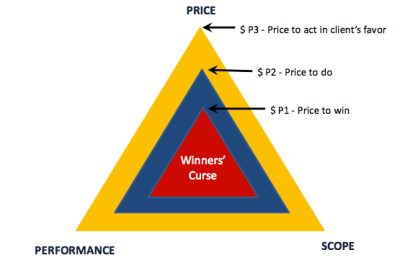
To better understand what happened, we have to look at the concept of the Iron Triangle (picture above).

The Iron Triangle reflects the basic three elements of a successful deal. These are:

  1. Scope – what the products / services are.
  2. Performance (Quality) – what standards are required for the products / services
  3. Price – what price will be paid for the products / services

Focusing on the Price levels for now, this concept depicts three different price levels with the analogous levels of Scope and Performance (Quality).

1. The Winner’s Curse – This is the price a bidder will bid in order to win a tender. (P1)

2. Price to do – This is the price required to do the job including a reasonable margin (P2)

3. Price to act in Customer’s favor – The highest bid of all which corresponds to the highest quality and scope (considered in Customer’s favor) (P3).

In the above example, what the IT department (the Customer) failed to understand is, that selecting the vendors based on the P1 price level (the Winner’s Curse) means that the Provider needed to cut corners to recover its cost and potentially make a margin.

On the other hand, the expectation the Customer has in terms of Performance (Quality) and Scope usually resembles the corners of the Triangle corresponding to price level P3.

This means that the eventual triangle the Customer would require consists of the highest Quality and Scope levels but the lowest price. This results in a skewed triangle and is unsustainable.

Hence, what ensued the deal in the above example was the breakdown of the relationship and the spiraling of costs.

So, reflecting on the Iron Triangle, sourcing should be a search for the best value for money deal, taking into account the Scope, the Performance and the Price from the start.

TIPS TO AVOID BEEN CAUGHT IN THE WINNER’S CURSE

So, what are some tips to avoid been caught in the Winner’s Curse?

  • Be informed about what you want (specifications), how you want it delivered (quality), what value-additions are required (if any).
  •  Be in the know, from a Total Cost of Ownership (TCO) perspective e.g. estimate the transition costs for changing suppliers (should you want to add them in the mix) etc
  • A deal made must include clarity around these three items Scope, Quality and Price. Be sure to cover all of those from the start.
  • Have a variation process agreed.
  • Have an exit strategy should things go wrong.
  • Know the triangle you are in at every deal and prepare for any shortcomings if in fact you are forced to go for a winner’s curse.

Do you know what triangle you were part of the last time you did a deal?

Image courtesy of Sara Cullen / www.whiteplumepublishing.com

If you want something complex done well, give it to a busy person!

We have all heard the phrase “If you want something done, give it to a busy person”. We all felt that there is some truth in it.

Research done by Dijksterhuis and van Olden recently seems to take this insight to another level.

The research was performed on how Decision Making and the likelihood of  Regret are linked and produces some very interesting results. Let’s look into it.

THE EXPERIMENT

As mentioned in Richard Wiseman’s book 59 Seconds, a few years ago Dijksterhuis and van Olden conducted a study whereas, subjects were shown five posters and were asked to use three different techniques to make a decision. At the end of this process the subjects were given the poster of their choice and a month later the researchers called them and asked them how they felt about their decision and what amount of money would it take to part with their originally chosen poster. The results are surprising.

At the time of the experiment the researchers broke the subjects into three groups.

  1. The first group was asked to immediately choose the poster they liked the most.
  2. The second group was asked to study the posters well, list what they liked and did not like about them. Only then, to make a decision and choose a  poster.
  3. The third group was quickly shown the posters and then they were asked to do anagram puzzles for 5 minutes. Only after this process, they were asked to choose a poster.

At the end of the experiment, all subjects from all three groups were handed over the poster of their choice, and then a month later they were asked how much they liked the poster then and how much they would sell it for.

Surprisingly, at the time of the experiment the subjects in Group number 2 (the ones that were asked to carefully consider the pros and cons) were the most confident they had made the right decision.

A month later though, it was a completely different story.

Group number 3, (who was shown the posters quickly and then did puzzles before eventually making a choice), were the most attached to their chosen poster and wanted more money to part with it.

WHY GROUP NUMBER 3? THE THEORY OF THE UNCONSCIOUS THOUGHT

The explanation of this behaviour is attributed to what is called, the theory of the Unconscious Thought.

A good summary of it can be found here and below.

Unconscious thought theory (UTT) was first presented by Ap Dijksterhuis and Loran Nordgren in 2006. UTT posits that the unconscious mind is capable of performing tasks outside of one’s awareness, and that unconscious thought (UT) is better at solving complex tasks, where many variables are considered, than conscious thought (CT), but is outperformed by conscious thought in tasks with fewer variables. This is a countercurrent position, as most research on UT since the early 1980s has led to its being characterized as simple and incapable of complex operations. Dijksterhuis’ and Nordgren’s theory is based primarily on recent findings from a new experimental paradigms.

The interesting article, titled, The Beautiful Powers of Unconscious Thought by Dijksterhuis himself (here), elaborates on the facts and nuances of these important findings.

PUTTING THEORY IN PRACTICE

So, what does this mean in practice for everyday work life?

Well, I think that this data supports the position that managers, supervisors and organisations need to make an effort to fill the days of their teams with meaningful projects and try to engage them (ideas on how to do this can be found here and well as a method on innovation here and here).

Moreover, as mentioned here we have to move one step forward from being busy to becoming productive as, the key question is not if we are “doing” something but if we are “effective” in what we aim for.

Hence, the organisations need to create an environment conducive to best utilise the theory of the Unconscious Thought aiming of course the more complex of projects. I trust that more research will be done on these important findings in the future that will verify and expand our understanding in this important field.

How did you handle your last complex task allocation?

Image of Ap Dijksterhuis courtesy of Radboud University Nijmegen / www.ru.nl

“All models are wrong but some of them are useful”

This is my full article contribution as published in Procurement and Supply Australasia earlier this week.

There are times that we get so engrossed into the black and white way of thinking that we forget that life is far from having absolute truths.

George Box put this in a succinct way:

“Essentially, all models are wrong, but some are useful”.

                                              George E.P. Box (Statistician)

Math model

WHAT IS A MODEL?

A model is a particular way of interpreting the world. A great definition can be found here:

“A representation of a system that allows for investigation of the properties of the system and, in some cases, prediction of future outcomes”.

We have been using modelling since times immemorial as, it is our means of understanding the world. Models have always superseded older versions or worked alongside each other satisfying different targets.

e.g. Isaac Newton had conceived a very elegant model of understanding the cosmos which worked very well until it was superseded by Einstein’s (see here for details).

Well, it happens to the best of us.

PROCUREMENT AND GEORGE

George Box’s quote above is relevant to any discipline.

Specifically, in Procurement we have many models we are working with: RFP, RFQ,RFI, Krajlic, ROSNA, Pareto, ABC and the list goes on. But, there is not one of these though that can apply to all situations.

As an example consider this:

If the requirement is to simply get the best price e.g. for commoditized products in fragmented supplier markets, then a strong candidate to use as a model is an RFQ tender.

The RFQ model though is not working for e.g. high spend/high risk categories. That is where you would want the supplier to invest in the relationship and collaborate achieving innovative customer solutions as you are probably also targeting new product development.

Especially when in today’s world the battle is between Supply Chains and not organizations in isolation, strategic alliances are becoming key differentiators for organizational success. RFQs as well as other transactional Procurement techniques do not work for developing such relationships.

I know that we all have personal favourites.

Models that may have produced great successes in the past. So, deep inside we tend to give these models more credit than they deserve.

The important thing here is to recognize every model for what it truly is i.e. just one more tool in our toolbox to choose from and use.

Reading, discussing with colleagues, experimenting,continuously learning allows you to expand your toolbox enabling yourself and your organization to choose wisely the right model for your next procurement project.

So, when on your new procurement project remember dear old George and spend time in choosing the right model for your targeted outcome, because:

“All models are wrong but some of them are useful”.


[Image courtesy of fdecomite / flickr.com]

Logical Fallacies: Avoiding Common Negotiation Pitfalls

This is my full article contribution as published in TheSource e-news earlier this week.

Fail to prepare and prepare to fail! Negotiation is often 90% preparation and 10% execution and so we have enlisted senior procurement professional George Vrakas to give us his top tips on avoiding common negotiation pitfalls.

When you use logic as your approach to conduct a negotiation, the human element of the process still needs to be considered, and thus you need to be able to identify and avoid common errors in reasoning (the so-called logical fallacies) to ensure a successful outcome.
Here are George’s top 6 tips on dealing with the most common logical fallacies:

medium_8437944449

1) AD HOMINEM (go against the person not the argument)

Definition: This is encountered when someone tries to counter a claim or a position by attacking the person rather than addressing the argument.

Example: “The current system is ineffective; the vendor who implemented it was only bothered about saving costs.”

Attacking the vendor because of their alleged motives does not address the issue. What is meant by “ineffective”? What were the specifications we gave the vendor? What can be done about it? Is the system used properly? What you need to remember is that character flaws are not evidence of the validity of an argument.

2) FALSE DICHOTOMY (either/or)

Definition: This is encountered when someone reduces the possibilities in a negotiation to a simplistic dilemma i.e. it is “either black or white.”

Example: “Japanese car makers must implement green production practices, or Japan‘s carbon footprint will hit crisis proportions by 2020.”

This is a logical fallacy because it assumes there are only two options: either Japan implements green production practices or Japan will have a disastrous carbon footprint. This logic fails to consider that there may be other reasons that contribute to the carbon footprint. It also limits our thinking e.g. focusing solely on green production we may miss out on another solution such as the increase of use of public transport.

3) SPECIAL PLEADING or ADHOC REASONING (the rules don’t apply as I am special)

Definition: This is encountered when someone suggests that he/she has special privileges that do not or could not apply to others.

Example: In 1996, Steve Jobs exercised a special pleading when he, misquoting Picasso, stated that “good artists copy, great artists steal,” and continued, “we have always been shameless about stealing great ideas.”

Subsequently, Apple went on with a lawsuit against HTC for allegedly infringing on 20 of Apple’s patents. Thus, this is a logical fallacy because what Steve Jobs implied is that Apple can “copy” or “steal” ideas as good artists do, but HTC cannot.

4) APPEAL TO AUTHORITY (It is correct because he/she said so)

Definition: This is encountered when someone appeals to an “authoritative” person or agency to support one’s claims. i.e. “Manager X believes Y, Manager X speaks from a position of authority, therefore Y is true.”

Example: The Swissair airline was once so financially solvent it was called the “Flying Bank.” However, they began to believe they were invulnerable and as a result of failing to question poor decisions and gross mismanagement, and the airline eventually went bankrupt.

This case strongly implies a case of “groupthink.” Instead of looking at the data and the shifting conditions, Swissair executives seem to have been persuaded that top management knows best, and so, did not challenge this notion until it was too late.

5) NON SEQUITUR (It doesn’t follow)

Definition: This is encountered when someone reaches a conclusion which does not necessarily follow the premise of the argument.

Example: “This is new, therefore it is better.”

The fact that something is new and shiny does not mean that it will be better. New processes are generally an enhanced version of older ones, but before you make a decision, you will still need to investigate on whether: a) there is value in changing; b) the process is suitable for your specific needs; c) there are no inherent flaws etc.

6) APPEAL TO TRADITION (If it ain’t broke, don’t fix it)

Definition: This is encountered when someone claims that because something has been done in a particular way for a long time, this is the correct way of doing it.

Example: “We do not need a new ERP system. We have been doing alright using excel spreadsheets for years!”

Quite simply, there is definite value in looking to change the ways we go about things – new technologies (e.g. ERP systems), new processes (Six Sigma, Lean, TQM), the list goes on. Appealing to tradition is particularly prevalent during change management processes when people who are resistant to change raise this argument again and again.

The above six logical fallacies are just a small sample of the wide variety of bad reasoning out there. However, these are a good start on the journey to establishing integrity in logical arguments during a negotiation.

Now, put them to the test in your next negotiation!

[Image courtesy of Les Haines / http://www.flickr.com/]